
<!–
/* Style Definitions */
p.MsoNormal, li.MsoNormal, div.MsoNormal
{mso-style-parent:"";
margin:0in;
margin-bottom:.0001pt;
mso-pagination:widow-orphan;
font-size:12.0pt;
font-family:"Times New Roman";
mso-fareast-font-family:"Times New Roman";}
@page Section1
{size:8.5in 11.0in;
margin:1.0in 1.25in 1.0in 1.25in;
mso-header-margin:.5in;
mso-footer-margin:.5in;
mso-paper-source:0;}
div.Section1
{page:Section1;}
–>
[The following post was written by Liz Wessel, R. N. a Mission Director at Saint Joseph Health System based in Orange, California]
Recently, I spent three weeks living as an uninvited guest at Mount Sinai Hospital. My mission was to be a caregiver
for my brother John who has a cancerous tumor that tragically and painfully, is
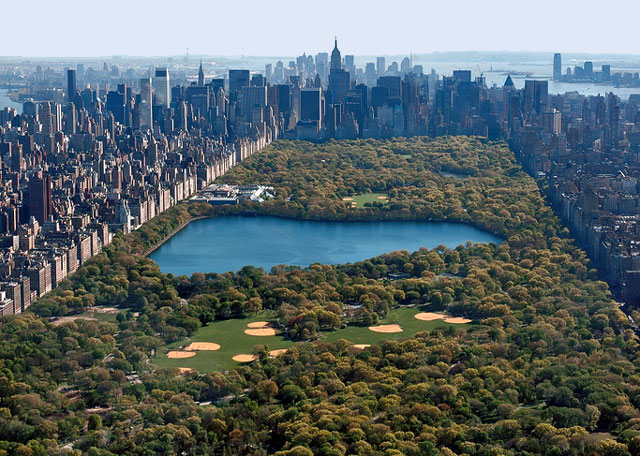
ravaging his body. The hospital is located on Fifth Ave in Manhattan and is directly across the street from Central Park.
Sometimes, when family members visited, I would go for a walk there. As I began to explore Central Park, I admired her earthen loveliness that is home to ancient shade
trees, playgrounds, baseball fields, ponds and so much history.
Eight-hundred
and forty-three acres of grand Mother Earth nestled between the concrete and
steel of New York City's big pulsing heart. Her welcoming arms draw close a diverse population into a community. For me, she provided brief periods of respite from the heartbreak of witnessing my brother suffer.
As I traversed her winding paths, I delighted in all the people I passed and the animated sounds of life. People jogging, bike riding, roller skating, live music, lovers strolling, people fishing, and families out to watch their kids play sports.
However, it was children’s laughter that I found particularly hopeful. A professional dog walker held reins on 16 dogs of every
imaginable size and shape. These tailwaggers were conspicuously well
behaved. I observed that people did not necessarily say hello, only occasionally
smiled if eyes met. Yet, they were quick to converse with one another when
petting a dog, exchanging nanny stories, or the likes. I do not believe New
Yorkers are unfriendly as their stereotype often depicts. It is more that they do
not really notice you. Maybe this is intentional in such a crowded town, where
people respect the need for space and do not impose themselves or crowd you.
While I walked along, I noticed a beautiful spontaneity in peoples’ faces. They
were not self-conscious or even aware of passersby but were naturally engaged
in their own world. As I continued, I had an unusual experience, or shall I say, a DNA remembering. On a cellular level, there seemed to
be a familiar recognition that I was in the home of my birthplace and a comfortable
feeling flowed through me.
During my last week at Mount Sinai, I had the good
fortune of discovering Central Park’s Conservatory,located just three blocks from the hospital at 105th Street. At the entrance to the garden is a wonderfully large antique wrought iron gate made in France by the American architect
George B. Post. As I stepped from drab concrete world into another land I beheld a magnificent view of a spacious Italian-style
garden with manicured hedges as margins. An elegant geyser fountain, perched at the
center, offered a refreshing cool mist that quelled summer’s heat.
At the far
end of the green was a series of tiered hedges. Stone steps led up to
a curved, wrought-iron, wisteria-laden pergola, a sacred space holding untold memories.
On the pergola walkway were medallions inscribed with the
names of the original thirteen states. I could not help but imagine all the
people who had come before me as lovers, families and friends, all participants
in life’s celebration and of life’s longings. I listened closely. Stories revealed themselves in whispers on the summer breeze.
On both sides of the green was a graceful alleé lined with
apple trees. Their branches formed a heavenly canopy of shade mingled with
filtered sunlight. Benches invited leisure and pause for reflection. In the
moment’s calm, I sat motionless and watchful. Soon birds felt safe to
descend and peck at fallen apples, the size of cherries. Robins, sparrows, a woodpecker and some jays reveled in
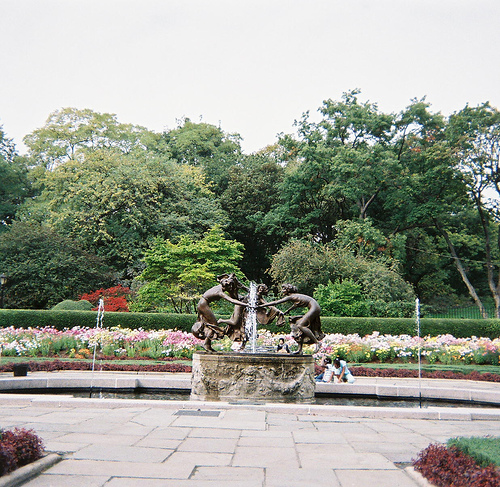
nature’s utopia. The famed German artist Walter Schott sculpted this fountain
in 1910, and the Untemyer family donated it to the Conservatory in 1947. A mixture of
flowerbeds surrounded the area creating a vibrant tapestry.
I was eager to bring my
sister Pat and my brother Tom to share in the healing experience of the garden.
On both of their tours, I saved the best for last, an English garden that
displayed a whimsical sculpture of a boy and girl. These bronze figurines represent characters from
my favorite childhood book called, “The Secret Garden,” by Frances Hodgson
Burnett. Artist Bessie Potter Vonnoh designed the fairy-like fountain in 1936. It sits within a reflecting pond mirroring delicate water lilies
and goldfish that swim serenely. Beyond this secluded area (known to
some as the Butterfly Garden) was an array of
living art and flowering plants resplendent in a variety of textures that blended
into a masterpiece. Butterflies and hummingbirds fluttered and darted.
I knew
that in a building not far away, many lay suffering. I would return to that place soon. Meanwhile, I was thankful that, at
least in this park, beauty blooms.


 Journal of Sacred Work
Leave a comment