
He was hungry so he came to the food pantry at a local charity. He was also drunk, so drunk that he collapsed to the ground several feet from the door. He was also dirty, so dirty you could smell him many feet before you got to him. To top it off, the food pantry had closed.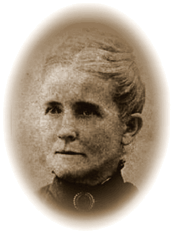
But the folks at the Martha O'Bryan Center are accustomed to such sights. Martha OBryan (left) didn't start this charity in 1894 to serve the rich, the clean and the perfumed. The charity is planted as an oasis in the middle of one of Nashville's poorest neighborhoods. Still, caregiving asks so much that some caregivers can "go numb" in the presence of need. After all, the food pantry is closed, the man is drunk, dirty, poor and late. If you work at the center, why not just climb into your car and go home?
While Marsha Edwards, the Center's director, went to get food, a fellow caregiver, Sharon Brown, went out to greet the hungry man who lay semi-conscious on the grass. "When I came out of the pantry," Marsha told me, "there was Sharon with the hungry man. Sharon wasn't just standing there, she was down on the ground cradling the man in her arms. She was stroking his face and his dirty hair and she was telling him we loved him."
Food came. But, more important, love arrived.
In a very different place and time, I remember another kind of love offered by my mother-in-law to an old friend. A stroke had transformed this old friend from a nice person into a mean-acting witch who growled at everyone who approached her. "What are you doing here?" the woman would snarl at my mother-in-law every time she approached with flowers, food and good will. "I'll bet you're the one who stole my purse," she would accuse.
But, my mother-in-law continued to visit, choosing to see the divine beyond the "unlovable" exterior this woman showed to the world. Other than a paid caregiver, my mother-in-law became this woman's only visitor. Who else among the once large group of friends would want to put up with the verbal abuse this women rained down on anyone that came within her distorted view?
It's one of the greatest challenges of caregiving. It is also the thing that distinguishes great caregivers, great teams, and great organizations from everyone else. It is the ability of loving caregivers to look past the gnarly surface of some of those in need to focus on the divine within. Paid caregivers and volunteers alike face these challenges everyday. We all know what Good Samaritan care is about. Everyone is lovable, but many may have moments when they seem unlikable. Transactional caregivers often discriminate against the unlikable, ignoring their call lights in favor of visiting the "nice" patients.
How can we develop cultures of caring that transcend "likability" so that every patient in need receives loving care?
-Erie Chapman


 Journal of Sacred Work
Leave a comment