"My water will be like a stream that gives eternal life." John 4:14
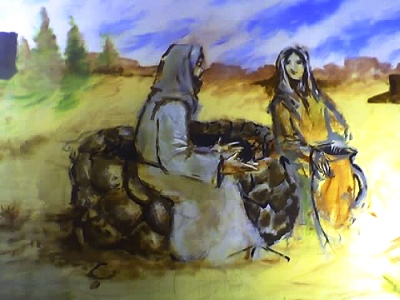
Woman at well

   The ancient story of the woman at the well has been retold for centuries. Anyone who has heard this story understands except for one person. She is the Samarian woman who comes to a well for water. Jesus tells her that with his "living water" she will never be thirsty again. But she does not comprehend his message.

   Do we, as caregivers, truly comprehend the power in Jesus' words? If so, why do we thirst? 

   Speaking only for myself, I know that I not only need, but am often desperate, for the love of others. As I age in a country where youth is king, I can feel people seeing me differently. To some, I may no longer appear like the energetic leader who once wielded a small amount of "power" for awhile. Increasingly, I may seem irrelevant.

   When I find my thoughts turning this way I start feeling abandoned. In my self-pity, I search, like the woman at the well, for something I think will satisfy my worldly thirst – my need for affirmation.  

   This search, of course, is foolish and cannot have a good end. Love is always available to all of us – especially when we stop searching and simply receive God's gift.

   This is the news Jesus offered – to know that we are always loved and can love others with no fear that the well will run dry. It is a gift those of other faiths also receive in another way. We can all know God's Love.

   Caregivers, who may experience isolation on the night shift or in the middle of the day, know the sadness that rises in the heart when the dragon of abandonment appears. Where is Love at times like these? Where is the God who is supposed to comfort us in our grief?

   Of course, the answer is that God's Love is always present to us. We discover this when we let go of fear.

   Do you, as a caregiver, find yourself feeling "thirsty" in the middle of your work? What helps relieve this thirst?

-Erie Chapman    

5 responses to “Day 264 – Why Do We Thirst?”

  1. Karen York Avatar
    Karen York

    You have touched on a very basic need of all of us – the need for relevance and love. As humans we chase after it and often find only its fleeting substitute. It reminds me of the song “Looking for love in all the wrong places…” Sometimes, even in the most loney place, we hear no response. As you said, love is there. Rilke seems to understand as we writes…
    “I’m the one who’s been asking you—it hurts to ask–Who are you? I am orphaned each time the sun goes down. I can feel cast out from everything and even churches look like prisons. That’s when I want you–the knower of my emptiness, you unspeaking partner to my sorrow–that’s when I need you, God, like food. Maybe you don’t know what the nights are like for people who can’t sleep…The night is a huge house where doors torn open by terrified hands lead into endless corridors, and there’s no way out.
    God, every night is like that. Always there are some awake, who turn, turn, and do not find you…
    God speaks to each of us as he makes us, then walks with us silently out of the night…”
    Love is out there, but most importantly, love is in here – deep within our being We were created that way. We are love.

    Like

  2. erie chapman Avatar

    What a remarkable set of comments, Karen. Thank you so much for sharing the searing lines from Rilke. God, “the unspeaking partner to my sorrow…” Yes, we do look to God to meet our worldly thirst.

    Like

  3. ~liz Wessel Avatar

    I appreciate your candor, Erie and willingness to authentically share from your heart.
    A couple of years ago I went to a silent retreat led by James Finley. He gave a meaningful talk on the parable of the woman at the well which, resonates with the wisdom offered in today’s meditation. The following are my notes (paraphrased)from Finley’s reflections about what the woman did.
    “First she disappears- slips away, no one can see, but Jesus, the solitude of the great way. To become one with the treasure, with the hidden, you must become hidden. Look at what love has done to me.
    Second, she leaves her jug at the well-how do we know to abandon hope that we can live a life that can be contained? We give up the experience of being possessive of our thoughts. We no longer have thoughts, we ground ourselves, feelings do not belong to us, with an openness of heart we give up, we let them arise; gently release our grip in a spirit that sets us free.
    Third, she goes off with a contagious energy of being more awake than ever and with a childlike presence her heart is broken open to a Love that creates community. Wherever there is wakefulness and Love, an awakened heart, there is oneness with each other and God. There is a tireless nature of Love, it goes on and on and is all-inclusive. Whatever it means to be human and God is one, resting in God is a breakthrough realization.
    The ego wants to be the recipient of all the graces. The self dies along the way. Realms of having, fears of not having, we can get caught in self-deceptions of how we treat ourselves, others and the earth. When we choose not to Love, suffering arises. In honoring the gift of being human and acknowledging our brokenness, we can awaken to the woundedness that is perpetuated upon ourselves and others. Love is never imposed, only offered. Love gives all. We are endlessly loved, no matter what we say or do, neither here nor there, no matter how things turn out, we are loved in our brokenness.”
    In response to your questions, I recognize that in my attempt to reach God in lofty ways I may pass by the hidden in the ordinary of my day. When I see others as different from me, it becomes easy to objectify rather than to see a real person in front of me. What I thirst for is “neither here nor there” but is found in all.

    Like

  4. Julie Laverdiere Avatar

    I must comment on an earlier day this month, when someone said we are to love God, and the person in front of us. To me, especially if I am looking in the mirror, that means God and I are loved, and whether or not what time of day, a mirror is always close by. Thanks.

    Like

  5. ~liz Wessel Avatar

    The bud
    stands for all things,
    even for those things that don’t flower,
    for everything flowers, from within, of self-blessing;
    though sometimes it is necessary
    to reteach a thing its loveliness,
    to put a hand on its brow
    of the flower
    and retell it in words and in touch
    it is lovely
    until it flowers again from within, of self-blessing;
    – Galway Kinnell from the poem Saint Francis and the Sow

    Like

Leave a reply to erie chapman Cancel reply