"I feel your pain." – former President Bill Clinton speaking to victims of a natural disaster 

   When former President Clinton made the above comment he was ridiculed in the press and by every talk show host. I happen to have heard the comment at the time and I believe the President was sincere. We've all experienced pain in our lives and the President, growing up with an alcoholic stepfather, has seen his share. 
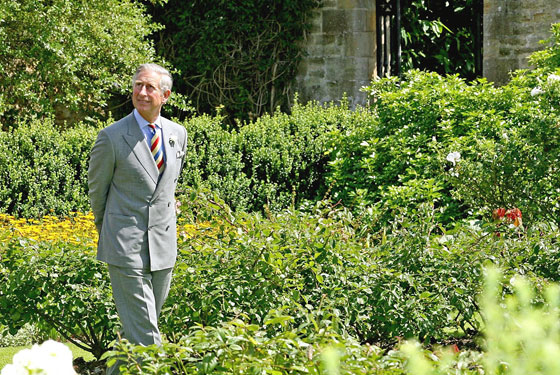
Prince charles garden   The truth is, the general public becomes uncomfortable when a prominent figure, especially a male, expresses sensitivity in a loving way. Prince Charles (left) in a very easy-to-ridicule comment, once spoke of how he loved his garden so much, he "spoke to the vegetables." Apparently, the prince had been warned against making such an open statement but he labored under the illusion that people would understand. They didn't.

   I am often confronted with this challenge when I speak about loving care with male hospital CEOs. "Could we use some other word than Love?" they ask me.

   Why is Love, which is the most important energy in the world, such a subject for ridicule and discomfort? Naturally, if leaders use the language of Love and don't live it, they aren't involved in Love's expression. More likely, loving caregivers and leaders are punished because the rest of the world feels uncomfortable that others are living what they are not. 

   Men can be strong, but loving references to males are usually limited to fathers and grandfathers. (He is a "loving father.") But, I'm not sure I've ever heard of a male leader referred to as a loving leader. 

   Imagine what the world of healthcare would be like if leaders actively and sincerely embraced the love that is contained in so many hospital mission statements. Meanwhile, caregivers are often punished if they step outside their job descriptions to live Love by helping others. Sadly, I have often seen and heard of this.  

   Hospitals are, by nature, rule-conscious. Sometimes, leaders forget that the rules of charitable organizations must always be guided by God's Love. 

   We remember who was punished so long ago for the way he carryied God's message of Love into this world. We just finished celebrating his birthday on December 25. 

-Rev. Erie Chapman

7 responses to “Days 6-10 – Why is Love Punished?”

  1. ~liz Wessel Avatar

    You raise an interesting phenomenon; it seems in general, boys receive a message growing up that it is not okay to express feelings. I hope that this is changing with each new generation. As I grew up saying, “I love you” was not something I ever heard or said. I recall when my dad was dying I told him, “I love you” and the closest he came to saying it back was, “me too.” In my own family I am comfortable telling them, and my friends, I LOVE YOU…”right out loud.”
    On this the day, the Feast of the Epiphany, I thank you for the epiphany you offer to us!
    I would like to share this excerpt from today’s Writers Almanac, “The word “epiphany” comes from an ancient Greek word meaning “manifestation” or “striking appearance.” Writer James Joyce explained to his brother Stanislaus that epiphanies were sort of “inadvertent revelations” and said they were “little errors and gestures — mere straws in the wind — by which people betrayed the very things they were most careful to conceal.” He also wrote that the epiphany was the sudden “revelation of the whatness of a thing,” the moment when “the soul of the commonest object … seems to us radiant.” In Joyce’s Dubliners he ends with a story set at a party for the Feast of the Epiphany, “The Dead,” and the story ends: “His soul swooned slowly as he heard the snow falling faintly through the universe and faintly falling, like the descent of their last end, upon all the living and the dead.”
    May we let go of our fear and share the epiphany of Love with one another and in our caregiving, may all our thoughts be transformed into Loving action! ~Amen

    Like

  2. Julie Laverdiere Avatar

    It is evident in our society, that men especially are not able to say the word Love. It seems to be too sensitive. I too, had a father who did not say it frequently. But when a man does have the courage to say it, it speaks volumes. I met a patient who was an Army colonel in the Green Berets in Vietnam. He was invited to give a speech at the graduation of army officers. His speech was about the most important task of a leader was to “love your men”. This was quite a speech, and well received. And, I know he knew how to modivate, and inspire his men by having that simple goal so essential in leadership. Just love them.

    Like

  3. Victoria Facey Avatar

    I was raised in a family where my parents did not verbally express their feelings to each other, nor to the children. Nowadays I’m described as a “touchy-feely” person; I am fine with this label. Life is too short to miss out on opportunities to show love and admiration. I admire the ocassional sensitive man; his visual reaction reminds me of being humbled, usually by something greater than ourselves.
    The leaders in the world, in business, industry and in politics could learn a lesson from this meditation, and a sensitive man.

    Like

  4. ~liz Wessel Avatar

    P.S. I don’t meant to insinuate that my dad was not loving towards me, for he was. He just was not able to express his love verbally, however, he was very affectionate towards me.
    Also, I think I kinda veered from today’s point but it was on my mind.
    Also, I loved Julie and Victoria’s posts today. how true and how beautiful!

    Like

  5. Kelly Roberts Avatar
    Kelly Roberts

    What an amazing reflection. Thanks everyone for sharing!

    Like

  6. Edwin Loftin Avatar
    Edwin Loftin

    There is no honor more humble than to be a part of loving, healing care.

    Like

  7. Diana Gallaher Avatar
    Diana Gallaher

    I have noticed that people will say, “love you” without the ‘I’. It seems that somehow it is more acceptable to say you love a person this way, than by saying it completely, “I love you.” I remember when my first nephew was an infant, less than a year old, hearing his other grandmother (not my mother) telling him over and over again “I love you” as she changed his diaper. My nephew of course was cooing and smiling in response.
    We all need to hear over and over again, starting as babies and throughout our lives that we are loved. The idea of “loving leader” sounds wonderful to me.

    Like

Leave a comment