
 [Note: The following essay was written by Liz Wessel, R.N., M.S., in her new role as a contributing writer for the Journal covering weekends. We are grateful to Ms. Wessel for her help and support.]
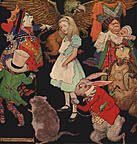
 "Who are you? Said the caterpillar…" "I-I hardly know, Sir, just at the present, "Alice replied rather shyly. "At least I know who I was when I got up this morning, but I think I must have changed several times since then."
~Lewis Carroll, Alice in Wonderland
Change is the one constant in life. Our country's current economic situation is wreaking havoc in the lives of so many families, friends and co-workers. The impact of the financial downturn seems to have a domino effect that is far reaching in magnitude. Future trends in healthcare, skyrocketing costs, controversy over healthcare reform, all point to the need for radical change and innovation. Proactive and forward thinking leaders recognize that in order to survive and thrive into the future we must reinvent ourselves.
Change may be necessary but that does not make it any easier to embrace. Understanding the change process can lessen stress and worry. Kurt Lewin's model of change describes three distinct stages. I find the analogy of an ice cube helpful in understanding these stages.
Stage I is the beginning of change, or the unfreezing of the ice cube. All transitions begin with an ending and accompany a loss. We must ready ourselves to let go in order to receive.
Stage II is the transition phase; the ice cube has melted and it is without form. This is an in between phase characterized by chaos. What once was, is no longer. But we have not yet transformed into something new. It is a dangerous time when people often lose heart and are confused.
Stage III is the end of the change, or the refreezing of the cube. It is a time of renewal, new energy, and the beginning of a new life chapter.
How can we help one another transition through change with the least amount of distress?
William Bridges recommends the following actions:
First, be reflective, take a step back and ask yourself, what is ending? What am I losing? (Control, purpose, understanding and support are common.) What is the impact on my life?
Remember, letting go is hard, even when we are looking forward to the change, so give it time and be patient. Consider creating a ritual to help mark the ending.
"You may feel in limbo waiting and wondering, this is a natural part of the process. Although life feels confusing it can also be a time of great creativity."
"It may feel like everything is up for grabs. What once worked no longer does. This distress is necessary as you move through the changes in your life. You may discover that your distress holds the clues to your relief."
"Just remember, 'When the student is ready the teacher will appear' and trust that you know what you need to do to move forward into your future."
(My learning's on change adapted from an in-service presented by Anne S. John, Organizational Development Expert, 2006.)
~Liz Wessel


 Journal of Sacred Work
Leave a comment