
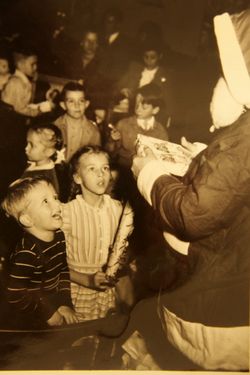
 Across six and a half decades, the wide-eyed-bursting-with-wonder little kid in the picture telegraphs to us an image of coming face to face with a god. He is an image of unbounded amazement.
My older sister Ann's expression reflects a different feeling. Opposing faces of joy and dismay, we signal our experiences of Santa. (Note the other kids in the background, all of whom had already met Santa.)
It took sixty-five years for Ann to reveal to me a secret about this photo. The event was held at the Hollywood, California YMCA which my father headed at the time. All children were told their names would be called to receive a present from Father Christmas.
Our names were never called. Dad didn't want it to look like the children of the boss were benefiting from a Y-sponsored event. He failed to share that crucial fact until afterwards.
Everyone raised with a belief in Santa reaches the day when myth melts into a new reality. How we respond to such news can affect our sense of trust.
Most seem to travel this passage with relative ease. After all, hundreds of myths collapse as we become older children and then teenagers.
There's no Tooth Fairy. The Easter Bunny doesn't hide those eggs. Superman can't really fly (Darn it!)
As these characters cumbled I shot a question at my dad: "If there's no Santa, what about God?" He assured me God existed.
But, I wasn't so sure. Maybe God was just another con game foisted on children by adults who knew better. I'd been tricked before. Was I being tricked again?
Why do so many enthusiastic children become cynical adults? Could it be they've been "conned" too many times?
Many adults continue the idolization game. We "believe" in movie stars and politicians for example – as superhuman people beyond we ordinary folks. Routinely, public examination reveals flaws and we are, strangely, surprised as well as disappointed.
How do we nurture belief and its attendant hope amid life's "betrayals?"
When my dad acknowledged there was no Santa he assured me there was other good news. There's "the spirit" of Christmas.
An invisible spirit is obviously harder to grasp than the apparent reality of something we can see. But the invisible holds a special power – it can be flawless.
The question is not whether our love is perfect but whether we, as humans, are able to let God's energy flow through us.
The world's cynicism blocks God's light. Still, we must retain enough discernment to live in society.
The door to Love's light is always open. The portal to our hearts will remain locked unless we can open enough to let Love illuminate our way.
What the best caregivers do is to help us keep our spirit's ajar. Christmas opens a window for us to revist Santa as a hopeful reminder of sharing. That giving is, of course, the mother of the love we call caregiving.
-Reverend Erie Chapman


 Journal of Sacred Work
Leave a comment