"In a dark time, the eye begins to see…/ The day's on fire/ I know the purity of pure despair…/The edge is what I have." –Theodore Roethke

   Nearly twenty-five years ago I interviewed a patient who had just finished her last round of chemo therapy. The occasion was my television show, "Life Choices with Erie Chapman."

   Her doctor said she was "cancer-free." She knew that also meant the cancer could return.

   "How do you feel now that you have completed treatment?" I asked. "Are you worried about the return of your cancer?"

   Her answer was startling:

   "Not at all," she replied. "I'm so grateful I got this cancer. Now I can truly see life. Before, I think I was blind."

   Joy sets the day on fire. So does agony.

   It is the bland space in between where we linger neither fully alive nor actually dead. Perhaps, fearing agony or boredom, we anesthetize ourselves and thus never see some of the richest colors in life's painting.
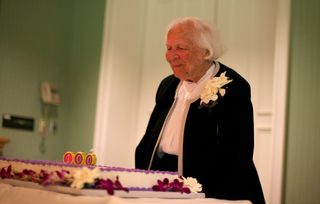
Mom after blowing out candles   One hundred years of living guarantees that there will be days of tragedy. My mother has been through enough of that to find serenity – or maybe she had it all along. You see her elegant light in another photo (left) taken recently by my daughter, Tia. 

   Some patients (and caregivers) who have been very sick or simply lived a long time understand the treasures of age and illness. Others block the inspiration that can come from facing into our hardest darkness.

   "I do strongly feel that among the greatest pieces of luck for high achievement is ordeal," the poet John Berryman wrote. 

   Who would want an ordeal? But, that is exactly what the courageous do. 

   "Why go through the pain of climbing Mount Everest," the bold are asked.

   The most common answer? "Because it's there." Why did Roger Bannister struggle to run the first four minute mile in 1954? Because he wanted to show what a human being could do. Why do saints like Gandhi and Mother Theresa and Martin Luther King choose painful paths to humanity? Because they believe their is nothing more important than Radical Loving Care.

   What we know is that it is impossible to "see" unless we first enter the dark and then, crucially, reflect on the experience.

   Pain is expensive. Why not let it teach us?

   Of course, pain will find us whether we seek it or not. The tragedy is that when we run from it too fast we misplace its most valuable lessions, the ones that open the eyes of our souls so that we can truly see.

-Erie Chapman

3 responses to “Days 233-235 – How the Soul Learns to See”

  1. ~liz Wessel Avatar

    Yes, your mom is aglow with Light. A person who loves his mother so, is hard not to love.
    One thing I have come to know is that when you give yourself to Love and you give all you have to the endeavor, and persevere, it becomes increasingly valuable. It is hard to let go and accept… what seems like defeat. But perhaps defeat is just what the ego sees; where love experiences endless beginnings. When a person is living with a life threatening illness and submits to a surgical knife, is willing to go into the pit of despair and endure unimagined suffering, it becomes hard to know where to draw the line. Fortunately, some people are able to rise above all odds like a phoenix and miraculously self-heal.
    I am experiencing a bit of a conundrum. I struggle with two schools of thought. Pema Chodron encourages us to lean in to our pain, to drop the story line and be fully present; divinely human, to lighten up and just notice with an attitude of curiosity and compassion. Her teachings resonate with me.
    Motivational teacher W. Dyer encourages us to replace painful thoughts with positive ones; to focus energy on the Divine light that is in each of us. To imagine how it feels to experience the desired future state realized. He recommends replacing painful thoughts with positive ones and thus become unstuck from repeating cycles.
    Then again, I recall a Hindu teacher who recommended that one need only become aware of whatever needs your attention and God will intervene. Perhaps, this is similar to Christianity in offering up our concerns to God; ‘to let go and let God.’
    “What we know is that it is impossible to “see” unless we first enter the dark and then, crucially, reflect on the experience”. Personally, there is an area in my life where I keep avoiding the painful truth of an ending. Acceptance is the path to peace. May we all experience a peace that surpasses all understanding.

    Like

  2. Karen York Avatar
    Karen York

    I don’t know that there is glory in suffering or remaining in pain. Realizing that it is inevitable, I know that learning from it and walking through it is crucial to growing. However, I’m not of the bent to seek out pain for pain’s sake. Maybe I’m not courageous, perhaps even a coward. Yet I believe that coming to acceptance with whatever painful experience I am having and moving through with grace are what is valuable for me. When the student is ready, the teacher will appear…sometimes in a glorious and happy way and sometimes not so much. In either case, it is good.

    Like

  3. Terry chapman Avatar
    Terry chapman

    Yes, pain can teach but often too slowly! When our son Daniel got A.L.L. ( Acute Lymphoceutic Leukemia) at age 3 1/2 it hurt a lot but later, when he was cured by chemotherapy at the University of Missouri Hospital & Clinics, we realize just how much our family, friends, church, and our prayers along with the superb medical care,
    had helped us move through the ordeal. Having said that, I am still unable to wish for pain for myself or others as a learning method. But again, experience is by far the best teacher.

    Like

Leave a comment