
 “There is no formula for generating the authentic warmth of love. It cannot be copied. You cannot talk yourself into it or rouse it by straining at the emotions or by dedicating yourself solemnly to the service of mankind. Everyone has love, but it can only come out when he is convinced of the impossibility and the frustration of trying to love himself. This conviction will not come through condemnations, through hating oneself, through calling self-love bad names in the universe. It comes only in the awareness that one has no self to love.” -Alan Watts
Alan Watts suggests that the world we see changes based on the magnification of the lens through which we gaze. He offers the illustration that if we enlarge a photo we see a bunch of dots but as we adjust the lens, patterns begin to emerge as the person’s face come into focus. On the other hand, if we look under a microscope we can visualize the life in a cell or the universe in atoms and particles.
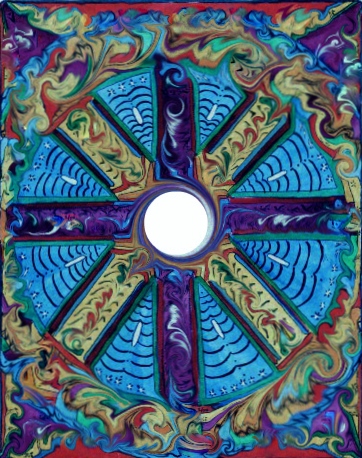
The Mandala (Sanskrit word or sacred circle) is a symbolic lens through which, I view the world. The circle represents the whole of life without beginning or end. In nature, everything has a polar opposite and one cannot exist without the other; night without day, winter without summer but together they form a whole. At the core of our being is this union of opposites as pure spiritual light.
As humans we could not experience joy without sorrow, new beginnings without endings, life without death. Yet, the lens through which we see ourselves tends to be myopic. The space between one person and another creates an illusion of separateness. However, Watt's contends that individuation is not separation for space actually connects us.
In caregiving sacred encounters seem to manifest in a realm of unknowing. In the in between space, we can let go of our need to fill the silence and open into the fluidity of the moment. When we listen wholeheartedly, our encounters with patients and family members offer little openings into more meaningful communication and connection. Perhaps a patient shares, "I do not want my family to know." This cue with an open ended response such as, "What concerns you most about telling them?” can be the bridge to deepening awareness and understanding.
In the in between spaces we are attuned to life’s natural rythms as we participate in the dance of life. Here we realize that you and I are intricately connected to each other and all that is through Love.
Liz Sorensen Wessel
Mandala by ~liz


 Journal of Sacred Work
Leave a comment