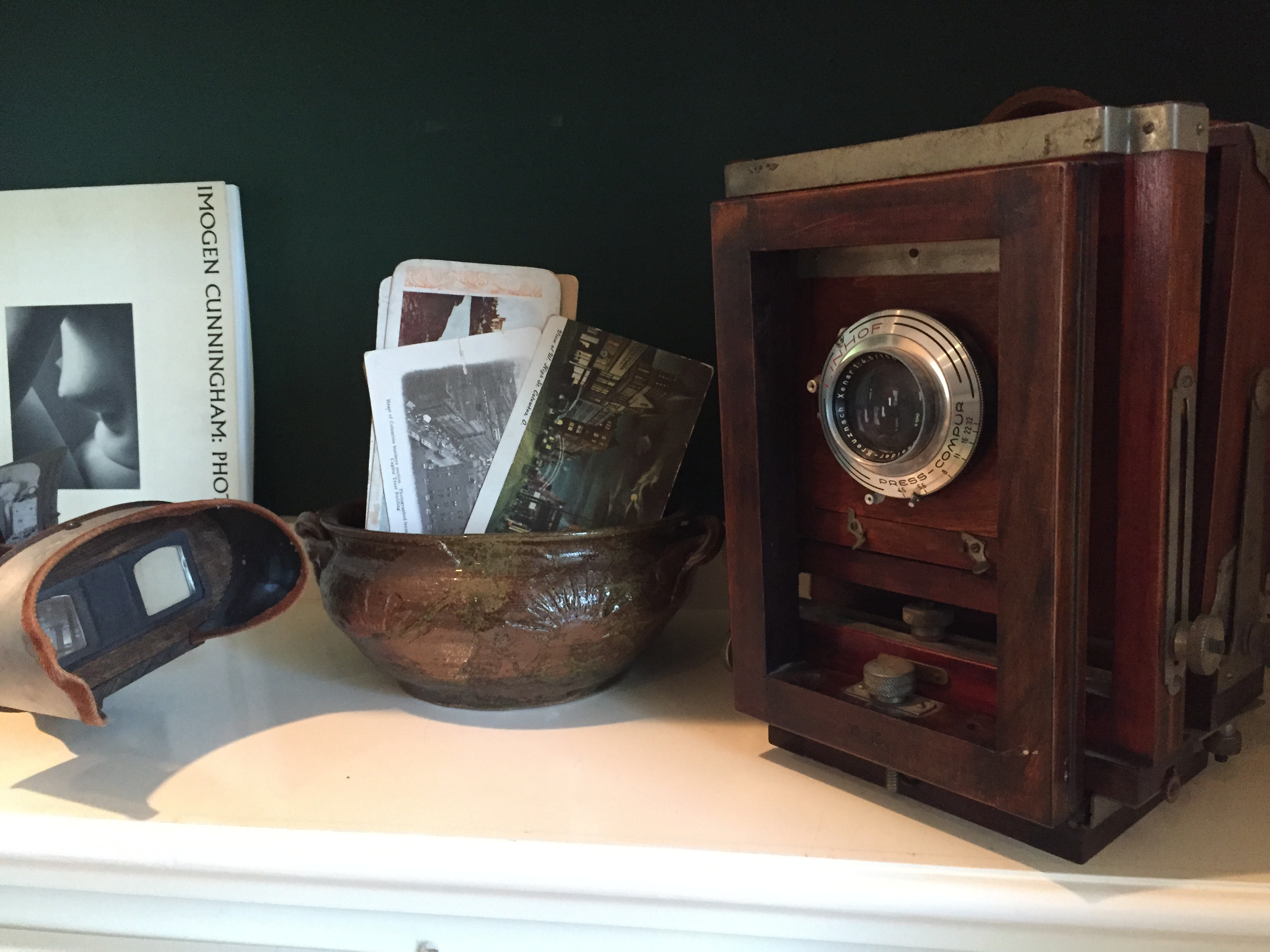
Old camera and eye "What we do during our working hours determines what we have; what we do in our leisure hours determines what we are." George Eastman, Founder of Kodak

   Yes. This is the day & week we focus on celebrating labor (a word that suggests something different in obstetric units.)

   Odd that the man whose labors enabled all of us to capture moments with the blinking eye of his camera for everyone (His famous quote was "You push the button, we do the rest)  would belittle our "working hours" as only determining "what we have" & leisure as signaling"what we are."

   But, everything points to who we are in this world. Ever the businessman (as well as inventor) Eastman was trying to aim our energy at leisure, the period during which we would use his portable cameras. 

   Labor Day offers such leisure. My passion for photo-art drives worry about the ease of cellphone pictures. As we scan hundreds of vacation images do we see or remember a single one? 

   Early on my passion for photography drove the use of old camera's like the one shown here even though smaller ones were available. You had to think hard about each camera blink because the loader only held two slips of five by seven film. But the silver prints from such large negatives made it worthwhile.

   I spent many darkroom hours turning dark into light. It was surprising to see how even then people barely glanced at the hard won images.

   "Light makes photography," Eastman wrote. "Embrace light. Admire it. Love it. But above all, know light. Know it for all you are worth, and you will know the key to photography.

  Your cell phone photos are one of the things that determine who you are. How you look at pictures is another.

-Erie Chapman

3 responses to “Days 250-254 – In the Blink of a Camera’s Eye”

  1. ~liz Wessel Avatar

    I find it fascinating to learn that you used old cameras to capture your art and then developed your own images. My father enjoyed photography and he had a darkroom in our basement where he developed his own photos. Oh, the magic of seeing an image appear on the paper. This slowing down is a great illustration of exploring the spaces in between (August 31st essay.) It seems an intuitive way to experience intimacy and a deeper knowing. There is something very elemental in participating in every step of a process. I can imagine the elation of discovering a portal entry into sacred ground; the soul’s garden. There is a fine richness in your photograph, Erie. You share lovely clues of a life story imbued with exquisite light, form and meaning. Thank you.

    Like

  2. sbeng@att.net Avatar
    sbeng@att.net

    Erie: you have a passion for photography and you spend countless hours in your dark room turning dark into light. “Light makes photography–embrace light, admire it, love it but above all know it for all you are worth, and you will know photography”. My thoughts go back to the Book of Genesis in the Bible. God created paradise and it was hidden till in the process of time He said “Let there be light” and the earth revealed was such a beautiful paradise for mankind to dwell. He created each one of us and gave us sight that we may enjoy His Creation, multiple and replenish the earth. We see the moon and the stars and we wonder at Him the Master photographer. We are reminded that each step of the way He lets us know that He still loves us and He still cares for each one of us.

    Like

  3. JVD Avatar
    JVD

    I like pictures and picture taking. At scripture class, while I was listening to the words, I silently was composing the shot in front of me…a young girl resting her head on her dad’s shoulder while he listened intently on the couch (framed to the right), (framed to the left) the preacher reading the text slowly using his index finger as a guide (the light subdued, emphasizing their eyes and the books pages). With an older style film camera I found it much easier to “see” the mode or shot and the colors that would result. When I started to go digital after my Minolta film camera was stolen, the pictures never looked the same. Colors were not there, focus was blurred and the timing of the shot was always much later than when I first snapped the shutter. Of course digital cameras have gotten so much better than then but the intimacy of the viewfinder I first found with film cameras has not returned in the digital age.
    In the beginning times of photography many spiritualists took up the art as they believed the mirrored image was a glance into one’s soul. It was a sacred reveal. But there were many others that thought these demon pictures were capturing a part of the soul.
    I agree that pictures are so every day that few stop and compose a shot. But like meditation is composing one’s thoughts, it is nice to share the experience after the light has exposed silver linings.

    Like

Leave a comment