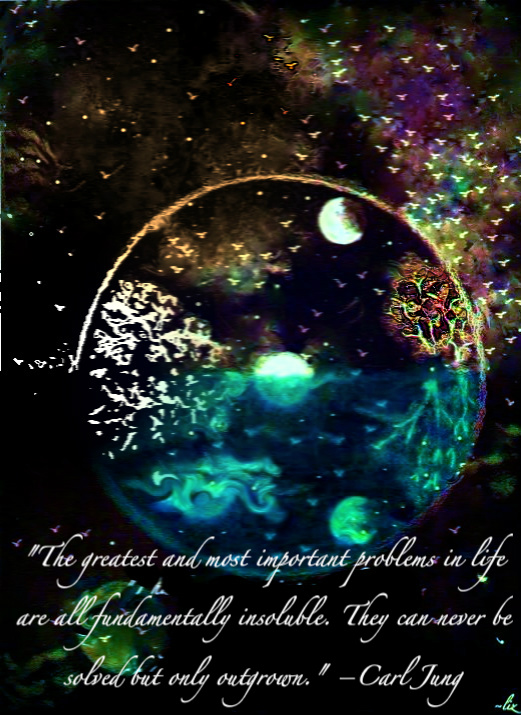
Only Outgrown

The following reflection contains a few pearls of wisdom gleaned from Fr. Richard Rohr’s book “Falling Upwards” as well as the wisdom from other spiritual readings along the way.

 As children we are naturally egocentric and believe that we are the center of the universe. In the first half of life our task is to develop our unique identity. We learn that in this world success is measured by being the best so we strive to achieve, accomplish, and set goals to reach the top.

We grow into adulthood, work hard to establish our careers, settle in, maybe get married and have a family. We learn to define ourselves through differentiation. Our minds label and categorize and we make judgments that determine our likes and preferences. Our preferences create emotional expectations and it has been said that “an expectation is a resentment waiting to happen.” Our thoughts solidify in black and white terms, and the either or of dualism.

Through the years, we become very attached to the identity we have created for ourselves. The problem is that we must constantly be on guard to defend and protect our carefully crafted persona in our desire to be loved and accepted. We are afraid that if people knew "the real us" they would no longer love us. 

Richard Rohr explains that universally we are all addicted to our ingrained ways of thinking. Basically, we want to get our needs met, we all have our fears, hurts, biases, limits and blind spots. The truth is we are often our own worst enemy.  Yet, Erie offered us another possibility in his powerful essay, "Days 271-275 Stop Beating Yourself Up!-The Art of Self-Kindness."

As we move through our days we inevitably experience the heartache of loss as our outer shell begins to crack. The falling away can create openings, as well as angst, as we confront our shadows and are humbled by our powerlessness.

We begin to free ourselves from the non-essentials  and focus instead on what really matters. Our world view shifts from an all or nothing mentality to a both/and perspective. We realize that expectations cause unhappiness and so we loosen our grip on our idealized notions. We honor all aspects of ourselves, our traditions and begin to live in communion.

In this second half of life, we explore the deeper meaning of our lives. Grace opens into the mystery of paradox, ambiguity and unknowing with new awareness and faith. For as Fr. Rohr affirms, we are being guided by the One who believes in us, knows us better than we know ourselves, and loves us so much more.

When in the soul of the serene disciple
With no more Fathers to imitate
Poverty is a success,
It is a small thing to say the roof is gone:
He has not even a house.

Stars, as well as friends,
Are angry with the noble ruin.
Saints depart in several directions.

Be still:
There is no longer any need of comment.
It was a lucky wind
That blew away his halo with his cares,
A lucky sea that drowned his reputation.

Here you will find
Neither a proverb nor a memorandum.
There are no ways,
No methods to admire
Where poverty is no achievement.
His God lives in his emptiness like an affliction.

What choice remains?
Well, to be ordinary is not a choice:
It is the usual freedom
Of men without visions.

By Thomas Merton

Offered by Liz Sorensen Wessel

Mandala by ~liz

10 responses to “Days 276-277 The Grace of Unknowing”

  1. Maureen McDermott Avatar
    Maureen McDermott

    How true your words echo in my heart, Liz and isn’t that because there is that ‘knowing’ when heart meets heart. Your words, “Grace opens into the mystery of paradox, ambiguity and unknowing with new awareness and faith” reflect the journey of life ever so clearly as we move into that time of greater freedom, love and trust; when we can admit we ‘know’ very little, yet are grateful for that inner knowing that assures us that we are loved and cared for in a way more wonderful than can be imagined. Thank you Liz.

    Like

  2. JVD Avatar
    JVD

    A Fall Awakening.
    To grow again with spirit.
    Spiritual love slowly breathing in.
    Exhaling, expanding outward like an embrace for the universe.
    Floating in a hot air balloon. What is there to fear?
    You are holding on. Your feet have solid footing.
    Afraid of heights?
    Then why are you flying in your dreams, floating with the air currents with your arms outstretched.
    Letting go of the attachment, the ritual of the day to day.
    Blowing the embers of spiritual love, allowing the glow to enlighten.
    Remembering that God was in our parents, is in our partners and in us.
    “When we feed and support our own happiness, we are nourishing our ability to love. That’s why to love means to learn the art of nourishing our happiness.
    Understanding someone’s suffering is the best gift you can give another person. Understanding is love’s other name. If you don’t understand, you can’t love.”
    ~Thich Nhat Hahn

    Like

  3. Diane Barrows Avatar
    Diane Barrows

    Richard Rohr and Pema Chodron both point to finding a place in ourselves wherein we can just “be”; be present to what is happening in this and only this moment, and being aware of our response to that moment. It is difficult to see and accept things the way they are because events, people and experiences, challenge, and sometimes attack, our self created perception of who we want to believe we are. Chodron* writes that if we can “allow ourselves to be inquisitive or open about what has just happened ….. “, to be aware of our “habitual reactions” when the rug gets pulled out from under us, we can begin to stop struggling ” to regain our concept of who we are, we can touch in to that mind of simply not knowing, which is basic wisdom mind”. “To be fully alive, fully human, and completely awake is to be continually thrown out of the nest”. When we can move into that radical acceptance we may find the path to being “completely alive by letting go, by letting ourselves die moment after moment, at the end of each out-breath”.
    * “When Things Fall Apart”

    Like

  4. erie Avatar
    erie

    First, Liz, thank you for your transcendent mandala and for adding Jung’s words.Next, thank you for quoting one of the four people the Pope referenced in one set of his remarks during his visit to the U.S. Merton’s voice remains one of the most beautiful among the thinkers of our time.
    “Our preferences create emotional expectations and it has been said that “an expectation is a resentment waiting to happen.” This may be one of the single most important truths we know. Expectations in relationships are a constant source of discord. Why do we do this to those we care about most? Do we want them to fulfill something missing in us or are we under the impression we can really make them “better people” by getting them to live up to OUR expectations.

    Like

  5. ~liz Wessel Avatar

    Today being St Frances Day I came across this quote and it seemed to companion this reflection and the comments of readers so beautifully; from a post by Kerry Walters
    “There’s an earthy literalism in Francis of Assisi, the Poverello, that I think fuels the fascination and devotion so many of us have for him. He was a guy who believed that when Jesus said “give all that you have to the poor and follow me,” he wasn’t kidding around. So many of us, myself included, suspect that Francis took the right path, and our better natures yearn to emulate him. But of course most of us, myself included again, don’t. This, by the way, doesn’t necessarily reveal us to be wicked or hypocritical, but only, perhaps, frightened.”
    “I suspect we’re also frightened to befriend all of creation, including Sister Death, with the joy and sincerity that Francis did.”
    “Maybe that’s the secret to spiritual development: to peel away, as best we can, and with God’s help, the material and psychological layers of insulation that we accumulate to protect us from everything we fear. The courage to strip ourselves naked, as Francis did in the town square of Assisi, to allow ourselves to be vulnerable, to face the wolf of Gubbio and to discover, mirabile dictu, that nakedness is something to be embraced rather than dreaded: perhaps that’s the holy key to Francis’s embrace of poverty, the key that explains why our hearts are quickened by him, even if we can’t forgo our own fears long enough to follow in his path.”

    Like

  6. ~liz Wessel Avatar

    Dear Maureen, thank you for your insightful response and for reflecting such a beautiful inner knowing…

    Like

  7. ~liz Wessel Avatar

    Thank you Jolyon for the overflowing abundance of your loving spirit.

    Like

  8. ~liz Wessel Avatar

    Hi Diane,and thank you for the wisdom you have shared and which I and Journal readers have benefited. “to be continually thrown out of the nest” Pema’s imagery resonates…

    Like

  9. ~liz Wessel Avatar

    Thank you, Erie.You pose a great thought provoking question, regarding relationships with those we care about most. “Do we want them to fulfill something missing in us or are we under the impression we can really make them ‘better people’ by getting them to live up to OUR expectations.”
    I think asking ourselves the question is helpful in increasing awareness and a change in thought can move us beyond our patterned behaviors.

    Like

  10. ~liz Wessel Avatar

    I am so grateful for everyone’s meaningful comments that have enriched this reflection tenfold. Blessings!

    Like

Leave a comment