
 There's something very interesting to understand about hope. That is, that hope and fear are one. Any time we're hopeful, we don't know it necessarily, but we're bringing in fear. Because fear is the constant, unavoidable companion of hope. What this simply means is that I hope for a certain outcome and I'm afraid I won't get it. I hope for a certain result and I'm fearful it won't happen. This is the way that hope and fear are wedded together. There is a place called, "beyond hope and fear." It is to be free from hope, so that we are free from fear.
So, it might be that the road to fearlessness is only found by giving up hope. By giving up outcomes, by giving up goals.
I find this to be an intolerable posture, by the way. If we don't have hope, where will we find our motivation? If we don't have hope, who will save the world? If we go down in despair – which seems to be the alternative to hope in many peoples' imaginations, who will save the world?
Can we work beyond hope and fear?
Can we find a way to be motivated, to be energetic, to be happy; to take delight in the work that we're doing that isn't based on outcomes, that isn't based on needing to see a particular result? Is that even available?
What if we could offer our work as a gift so lightly, and with so much love, that that’s really the source of fearlessness? We don't need it to be accepted in any one way. We don't need it to create any certain outcome. We don't need it to be any one thing. It is in the way we offer it, that the work transforms us. It is in the way we offer our work as a gift to those we love, to those we care about, to the issues we care about. It is in the way we offer the work that we find fearlessness. Beyond hope and fear, I think, is the possibility of love.
What would it take for us to just deal with what is? To not need to be always engaged in changing the world?
Yitzhak Perlman, the great violinist, was playing in New York. Yitzhak Perlman was crippled by polio as a young child, so the bottom part of his body doesn't work well and he wears these very prominent leg braces and comes on in crutches, in a very painful, slow way, hauling himself across the stage. Then he sits down and, very carefully, unbuckles the leg braces and lays them down, puts down his crutches, and then picks up his violin. So, this night the audience had watched him slowly, painfully, walk across the stage; and he began to play. And, suddenly, there was a loud noise in the hall that signaled that one of his four strings on his violin had just snapped.
Everyone expected that they would be watching Yitzhak Perlman put back the leg braces, walk slowly across the stage, and find a new violin. But this is what happened. Yitzhak Perlman closed his eyes for a moment. Yitzhak Perlman paused. And then he signaled for the conductor to begin again. And he began from where they had left off. And here's the description of his playing, from Jack Riemer in the Houston Chronicle:
"He played with such passion, and such power, and such purity, as people had never heard before. Of course, everyone knew that it was impossible to play this symphonic work with three strings. I know that. You know that. But that night, Yitzhak Perlman did not know that. You could see him modulating, changing, and recomposing the piece in his head. At one point, it sounded like he was de-tuning the strings to get new sounds from them that they had never made before. When he finished, there was an awe-filed silence in the room. And then people rose and cheered. Everyone was screaming and cheering and doing everything we could to show how much we appreciated what he had just done. He smiled. He wiped the sweat from his brow. He raised his bow to us. And then he said, not boastfully, but in a quiet and pensive and reverent tone,
"'You know, sometimes it is the artist's task to find out how much music you can still make with what you have left.'"
Sometimes, it is our task to find out how much music we can make with what we have left. What is the name that is big enough to hold your fearlessness that is big enough to call you into fearlessness? That is big enough to break your heart? To allow you to open to the suffering that is this world right now and to not become immobilized by fear and to not become immobilized by comfort? What is the way in which you can hold your work so that you do feel free from hope…. and therefore free from fear?
Excerpt from Article by Margaret Wheatley, March 2009, Shambala Sun
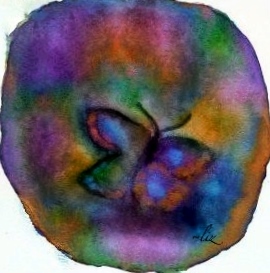
Butterfly Watercolor by ~liz


 Journal of Sacred Work
Leave a comment