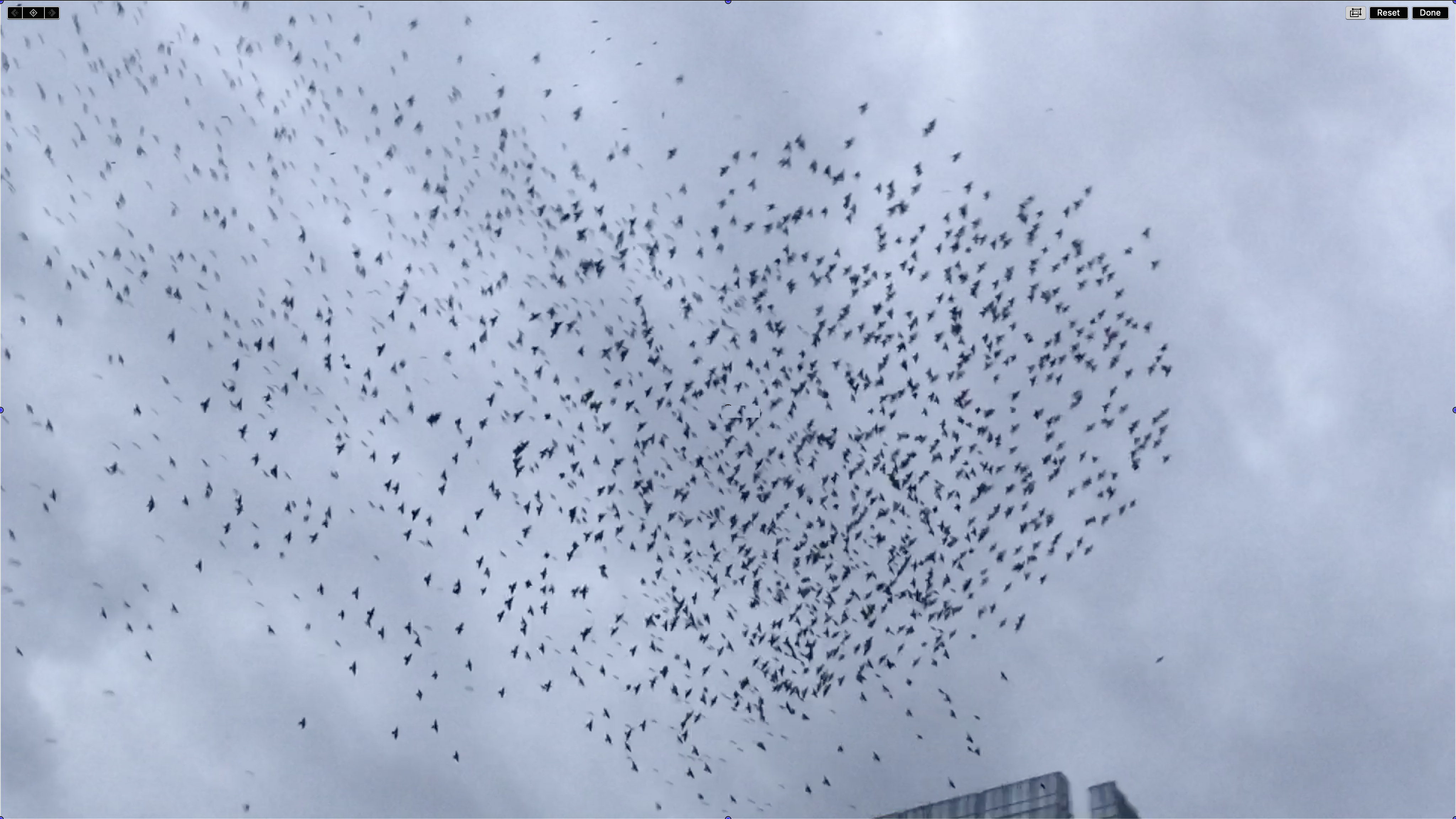
Murmuration  still   One memory you may have in your youth is when you suddenly could not recall the name of someone you knew well. That panic that sets in when you know you should know it, but you draw a blank – until you think about something else & your relaxed mind delivers the answer.

   It is a funny in your twenties. In your seventies, when the same thing happens, it brings a different kind of panic. "Am I getting Alzheimers? Is age attacking my brain?"

   Chances are, you are fine. But, bias against aging can make it hard to accept that truth – especially when younger people look at you & you know they are thinking: "Uh oh. Erie is getting old & his memory is failing."

   My theory is that a one reason healthy older people have memory problems is the huge volume of information we have collected – like a sky jammed with starling's murmuration. How many people you have met, medical words learned, books read, movies seen?

   No wonder that it becomes difficult to withdraw the right information you "know so well" from your brain's packed computer.

   Still it is a quandary. What to do?

Quandaries

We are not meant
to escape them,

not
for very long.

They are the songs
where, midway,
you forget the words & hum,

you & the band hoping
you will remember them.

If you do recall
you have a moment
to sit in the chair
that adjoins all quandaries,

rest from your quest
for a few moments at best
before the band strikes up
a tune you know
but cannot recall the words.

At least at first.

-Erie Chapman

Photograph: "Murmuration" by Erie

4 responses to “Days 53-57 – Quandaries”

  1. Liz Wessel Avatar
    Liz Wessel

    I can relate your thoughts on this topic as well as your wonderful poem, Erie!!!
    Yes, it is so true. I often find myself questioning my memory in relation to my age now…
    I can’t help but wonder if all the technology is contributing to distraction, and forgetfulness.
    Yes we carry a lifetime of learning and memories and our brain tend to filter to what is most important. That is the good news, Love is at the forefront. 🙂

    Like

  2. Todd Meador Avatar
    Todd Meador

    This is such a fascinating topic. The ideas and poem struck a chord with me and inspired me to do some writing on the subject today.
    Thank you Erie!
    — You are never too old to have a positive childhood.
    — Low self-esteem transforms a person’s memories of the past, view of the present and vision for the future.
    — If we change the meaning/significance we give the past and the stories we tell ourselves about it, our emotions will shift and transform how we remember it.
    — Through ‘free will’ we have the ability to transform our past, our childhood or any traumatic event.
    —What if you were able to consciously shape how you remember the past in a way that serves you or in inspires you to become a better version of yourself?
    —It can be done…
    .
    .
    .
    Our memories of the past are more fluid-like than many people realize.
    Our memories transform, as the meaning we give to past events, circumstances and people transform.
    Our memories also change, as the stories we tell ourselves about these events, circumstances, and people change.
    As we change our perspective about someone from our past, our memories with that person or during that timeframe change.
    These memories can change so significantly that we go from having a painful, traumatic childhood to one wrought with opportunity for growth.
    We can literally change our past, or at least how we remember our past.
    You are never too old to have a positive childhood.
    Our memories change when the stories we tell ourselves about our friends, family members and coworkers change.
    They also change when the stories we tell ourselves about a past event change.
    When we change the significance or meaning of the event, our memory of that event will change significantly.
    Perhaps most importantly, our memories change when we change the stories we tell ourselves about ourselves.
    What do you tell yourself about who you were supposed to be, what you were supposed to accomplish or how much money you were supposed to make?
    And what fortune or misfortune has come from those stories you told yourself and continue to tell?
    When you change the stories you tell yourself over and over, you can literally transform your past.
    Here is another piece of the puzzle.
    Our brain’s store and categorize memories in conjunction with emotions. Memories connected to stronger emotions are easier to remember.
    Think about a vibrant memory. Is it connected to strong emotions?
    How do those memories make you feel? Those feelings are the emotions connected to that particular memory.
    When our emotions change about ourself or an event, circumstance or person, our memory of past will transform.
    Here are some questions people often ask:
    What is the correct or right memory?
    How can a memory ‘really’ change?
    If my memory is stored in connection with emotion, is there a right or wrong emotion?
    Maybe it is more productive to take this perspective:
    This phenomenon of a fluid-like memory can either serve us or hinder us depending on how our brain is using it.
    If we do not realize our memory is fluid-like, our memory will be constantly transformed subconsciously.
    In this situation, we do not have any conscious control.
    We are at the mercy of the changing meaning/significance we give things, the stories we tell ourselves and the emotions connected with particular memories. We are also at the mercy of our beliefs and habits.
    This ‘autopilot’ mode could either serve or hinder us.
    If someone has a low self-esteem, this self-belief will influence:
    – memories of the past
    – experiences, opportunities and happiness in the present
    – and vision for the future.
    The beliefs and habits this person has developed will block possibilities and opportunities for their past, present and future.
    Low self-esteem transforms a person’s memories of the past, view of the present and vision for the future.
    If we are consciously aware that our memory is fluid-like, we can leverage this phenomenon to serve us. Awareness is very important here.
    If we change the meaning/significance we give the past and the stories we tell ourselves about it, our emotions will shift and transform how we remember it.
    Through ‘free will’ we have the ability to transform our past, our childhood or any traumatic event.
    Things to watch out for on your journey to become a better version of yourself:
    – The more we are attached to the meaning/significance, story or emotion related to a particular memory, the more difficult it is to transform the memory.
    – Consciously or unconsciously having a victim mentality.
    – Habits and beliefs that don’t serve you.
    Some of us are still hanging onto beliefs we chose to passionately believe as a child or were hammered in our heads by parents or teachers.
    Many of us are attached to the meaning or significance of a past event, or to the story we tell ourselves about it, or are even attached to the emotion we unconsciously bonded to the event.
    What if you were able to consciously shape how you remember the past in a way that serves you or in inspires you to become a better version of yourself?
    It can be done…because I have done it. And you can too!
    Good luck!

    Like

  3. erie chapman Avatar
    erie chapman

    Thank you so much for your thoughtful response, Todd. You are at such a reflective stage and I am grateful this post may have been of help to you.

    Like

  4. erie chapman Avatar
    erie chapman

    Thank you, Liz. Yes regarding the impact of technology as well. About 15 years ago my son-in-law said: “One day memory won’t matter so much. Google will take care of that.” I scoffed at the time. However he is both right and wrong. Google is huge in helping us both learn and recall. On the other hand, Google needs the help of our memories to know HOW to access assistance.

    Like

Leave a reply to erie chapman Cancel reply