
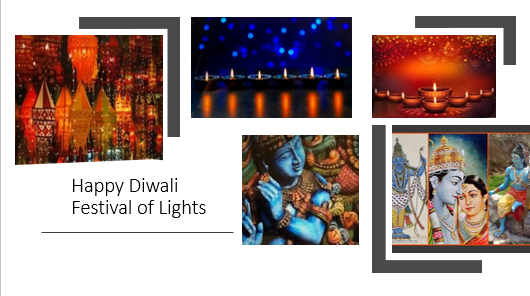
 In India and in many places around the world Diwali, the festival of lights is celebrated by Hindus, Sikhs and Jains. Diwali, is the most significant festival in Indian culture. On each of the five days of Diwali people celebrate with a sense of joy, friendship, and generosity of spirit and unites people everywhere regardless of religion or caste. The festival coincides with the Hindu New Year, a time of new beginnings, and symbolizes light over darkness (Nov. 2-6, 2021)
Historically, Diwali can be traced back to ancient India and began as an important harvest celebration with a festival of lights that stretches back more than 2,500 years. To Hindus darkness represents ignorance and light is a metaphor for knowledge. Therefore, lighting a lamp symbolizes extinguishing all negative forces through knowledge; violence, anger, envy, greed, fear, injustice, oppression and suffering.
There are various legends behind this celebration. The most popular legend is from the Hindu epic, Ramayana. As the story goes, Rama was exiled by his father King Daharatha, along with his wife Sita and brother Laxmana. Sita was kidnapped by the powerful demon King Ravana. The divine bird, Jatayu valiantly tried to fight Ravana off but he swiftly clipped the bird's wings and whisked Sita across the sea to his kingdom of Lanka. Rama with the help of friends made a bridge of stones that were blessed with buoyancy as they crossed the sea safely. In the fight of good over evil, Rama slayed Ravana, and rescued his beloved Sita. Victorious, they returned home and the people placed oil lamps to light their path to welcome them.
In the Jain tradition, Diwali is an important festival that marks the nirvana or spiritual awakening and enlightenment of Lord Mahavira, as the earth and heavens became illuminated with lamps in joyful celebration.
A major festival for the Sikhs, Diwali is celebrated as Bandi Chhor Divas, as a day of liberation. Historic accounts note that the emperor Jahangir decided to release Guru Hagobind who had been imprisoned for many years. However, the Guru would not leave unless all 52 princes who had been imprisoned with him were also released. The emperor said that only those who could hold on to the Gurus cloak would be allowed to leave. So, Guru had a cloak made with 52 pieces of strings and each prince was able to hold on and walk out with him. Their liberation was celebrated with the lighting of lamps, a tradition that continues to this day. I just love this story for their clever ingenuity!
In summary, the lights of Diwali symbolize a time to let go of our dark thoughts to receive the strength and the zeal to carry on with goodwill throughout the year. It is through light that the beauty of this world is revealed and experienced. Most cultures around the world recognize the importance of light as a gift from God.
As caregivers, you are a radiant light in this world and a true blessing and a gift to all who seek relief from the darkness of suffering.
In deepest gratitude,
Liz Sorensen Wessel


 Journal of Sacred Work
Leave a comment