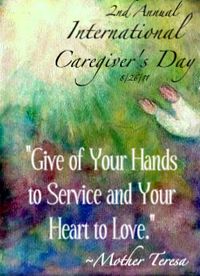
Int. CG Day8-26-2011 [Note: For our Second Annual International Caregiver's Day, Liz Wessel created some lovely images – one at left and the other is below. Today is a special time to honor caregivers everywhere.]

     On a recent family vacation a friend became irritated with something I said and (uncharacteristically) exploded into anger. I couldn't think how to respond. From my startled defenses, I glimpsed beneath his rage and saw the loving adult within.

   Instead of standing there feeling hurt, I needed to realize what some call "the grief beneath the grievance." To have a loving exchange, I needed to address his highest self, not the briefly fearful-sounding man before me.

   None of us can engage the divine in each other if we engage in combat using courtroom rules.

   A parallel truth lives in illness care settings. A caregiver cannot engage healing energy by quoting policies and rules to a patient in pain.

   Some of the people who entered my office during my decades as a hospital CEO were angry. Doctors arrived offended by some injustice. Family members complained of mistreatment. Employees felt unfairly judged.

   I was often more effective with them than with my family. I never began by arguing. 

   No distressed person wants to hear about the rules or be crushed by authority. Like anyone, they first want to be heard.

   "I'm so sorry for your trouble," I would sometimes say. It was surprising to see how often this diffused initial anger. After that, constructive solutions could emerge.

   I know the Divine lives within you and me. We know the divine lives in the other person.

   How do we address the highest self of the other when they are throwing their "lowest" self in our face? In spite of years of training and praying, I still find that I fail too often.

   I mistakenly think that the angry face before me IS that person. My Vanderbilt Divinity School friend, Diana Gallaher, taught me years ago that the person shouting at you is always "more than" that.

   It was another divinity school friend who expressed this idea in another way to me recently. "What if we speak to the "highest self" in the other? A great notion I lose when I am self-focused on hurt.

   We are certain to experience frustration with others again and again. It is part of the nature of relationships.

   That irritation may rise up as soon as today or tonight. Will we attack from our "lowest" self or will we be able to catch a shaft of light from the Divine and illuminate the highest self of the fearful person before us?

-Reverend Erie Chapman

Further Note: On August 26, 2009, we at the Journal created International Caregivers Day. Liz Wessel has created three beautiful paintings to celebrate our second anniversary. Below is the one of these. Thank you, Liz, for once again conjuring beauty for our readers.
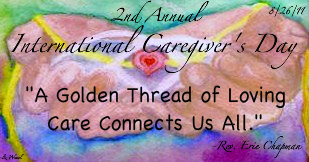
A Golden Thread 8-26-2011                                   Painting by Liz Wessel, 2011


4 responses to “Days 233-234 – Second International Caregivers Day – Recognizing the Highest Self in the Other”

  1. ~liz Wessel Avatar

    I had posted earlier today…but it apparently it did not save so I will try once again. Today’s subject is an important one to me. Unfortunately, growing up many of us did not learn good communication skills around conflict. We are wired to react with a fight or flight mentality. When a sudden tense encounter occurs, which often comes out of nowhere to catch us off guard, blood surges from our brain to our extremities preparing us for battle or to run. So, our reasoning mind is suddenly impaired. Personally, I tend to freeze up with fear and like a deer in headlights and I feel paralyzed, can’t think straight, and instinctively I want to take flight. Often, our motivations might start out positive, but in conflict, they can quickly revert to caring more about winning or being right.
    All this is easy to talk about and much harder to overcome. A current challenge that I face is noticing an elephant in the room and neither I nor another have found the courage to give voice to the concern. Fortunately fear, “is not all that I am.” My aspiration is to continually find my voice (no matter how often I stumble) and respond from the higher self that you speak of, Erie. Your insights are a helpful reminder. Thank you!
    Erie, I appreciate your wonderful idea to celebrate caregivers on Mother Teresa’s birthday 8/26/11. I am grateful for this opportunity to participate in honoring so many dedicated caregivers from around the world on International Caregiver’s Day!
    ~liz

    Like

  2. Victoria Facey Avatar
    Victoria Facey

    Erie, what a wonderful way to describe the noble act of addressing one who has presented their “lowest” self before you. Easier said than done, but a beautiful way to bring dignity into the situation. Often I’m caught off guard that I take the road of seeking forgiveness while trying to help to fix the issue at hand. You give me an exercise to consider so that we can both be at peace in looking for a amicable solution.
    P.S. I think Mother Teresa would agree with your reflection and appreciate you and Liz for your gift of recognition on this anniversary of her birth…

    Like

  3. Marily Avatar

    What a great reflection in today’s celebration! May we lengthen the golden thread of loving care that connects us all as we practice recognizing the highest self in the other… we may be caught off guard for just a second or a minute but think we have the brain cells in us what to do next.

    Like

  4. ~liz Wessel Avatar

    This morning I read this passage, which seems aligned with your reflection Erie, and I thought I might share it.
    “I think the contemplative mind is the most absolute assault on the secular or rational worldview, because it really is a different mind—a different point of view.
    The mind that I call the “small self” or the “false self” reads everything in terms of personal advantage, short-term effort, “What’s in it for me?”—and “How will I look?”, “How will I look good?” As long as you read reality from the reference point of the small self of “how I personally feel” or “what I need or want,” you cannot get very far. The lens never opens up.
    Thus the great religions have taught that we need to change the seer much more than just telling people what to see—that is contemplation.”
    ~Fr. Richard Rohr
    It is humbling to recognize how often I see through the eyes of my “small self” as much as I wish not to admit it. Yet let me recognize, so that my lens may begin to expand.

    Like

Leave a reply to Victoria Facey Cancel reply