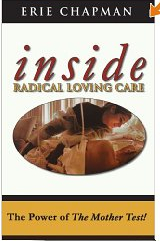
Inside radical loving care2

[Inside Radical Loving Care is now available at www.amazon.com, as a download to Kindle and all e-readers, and, for ten copies or more, by writing Van Grafton – vgraft@comcast.net.]


  "We deliver high quality comprehensive services to the local and extended community with excellence, compassion and competence." 

   Although the above lines are from an actual mission statement they could be part of any mission for any hospital. There are three things mission statements have in common: 1) They use high sounding words 2) Staff members don't know those words, 3) They are not true-to-life.

   If you want to verify this walk into any emergency department. Go up to the admitting counter groaning in pain. What will the clerk say? 

   The fact that you already know the answer tells you that the hospital is engaged in mission fraud. The clerk is likely to ignore your pain. Instead of a caregiver saying, "I'm so sorry you're in pain. We will help you," a form shoved at you will ask your name, address and insurance.

   Where's the compassion in the mission statement?

   Some hospitals are finally doing a better job but for the wrong reason – fear. Medicare now publishes patient satisfaction surveys and can penalize hospitals with low scores.

   How can hospitals raise performance to match mission?

   The answer is culture change. Organizational culture is driven by team culture. Both are created by leadership. The most important determinant of employee satisfaction is the attitude staff have towards their leader.

   Every hospital CEO can grow a culture of caring. It starts with holding every leader accountable for team performance and continues with training that teaches loving leadership. 

   1) BASELINE: Evaluate every team for competence and compassion (use subjective & objective approaches.)

   2) THE MOTHER TEST: Place teams in three categories following The Mother Test: a) "A" Teams: every member is someone you would want caring for you mother. b) "B" Teams: most members pass the Mother Test c) "C" teams: most members fail The Mother Test.

   3) TIME FRAME: The board or corporate office should give every CEO the chance to show positive change in one year and significant transformation in three years. The CEO should give every team leader three months to show improvement and six months to show significant advancement.

   4) THE TRAINER: Refer leaders of under-performing teams to a coach whose job is to train loving leaders.(Liz Vieira at Parrish Medical Center and Grace Ibe at St. John's Regional Health System already do this.) If there is no improvement in six months, replace the team leader. Note: top teams should be regularly recognized and rewarded.

   There is much more to it but this is the template. Radical Loving Care requires a "tough-minded tender-hearted" approach. There is nothing compassionate about letting second rate team leaders lead or letting second rate caregivers look after patients.

   Our mothers have a right to expect loving care from everyone. So do we. 

-Erie Chapman

4 responses to “Days 195-197 Mission Fraud vs. Mission Meaning”

  1. Maria Doglio Avatar
    Maria Doglio

    This commentary reminds me how I often think about how ministries get sucked into the typical corporate culture and their mission statements and values start to have gray areas right down the line from leadership to staff.
    Can it be avoided? Can a ministry maintain a different corporate culture that maintains in its highest values for care and personnel as well? Can they still be successful or do they have to follow a corporate norm, even if it may compromise values? Do they have to stay small to accomplish this? (Small is Beautiful!) I keep thinking there must be a different way to conduct business with out getting caught in the ruthlessness of corporate norms, because the old ways just don’t work anymore.
    It’s an intricate web — what are your thoughts Erie? Am I off the wall or can a corporation run it’s business from it’s heart?
    PS: I just gifted my son, who finished his first year of nursing, with two of your books. Thank you.

    Like

  2. ~liz Wessel Avatar

    love your fruitful inquiry, Maria which offers one much to ponder. I hope you will invite your son to join our conversation. I know of no other better way to incorporate the teachings of RLC than to read Erie’s essay and to formulate a response. The process causes one to think about how to directly apply it in one’s own life and work.

    Like

  3. ~liz Wessel Avatar

    This is a powerfully instructive essay Erie. Congratulations to Liz Vieira at Parrish Medical Center and Grace Ibe at St. John’s Regional Health System. Personally, I find the Mother test is a great litmus test for my encounters. I truly keep this in mind when I do outreach calls with patients/family members. I find that the most rewarding aspect of my job is patient advocacy. At times, I have focused mostly on my own actions and behaviors thinking that it is within the sphere of my control.
    Yet, the bigger lesson that I am presently living is the recognition that I/we cannot be successful in achieving quality care without the entire ecosystem of a team working in sync with one another. Everyone is entirely interdependent in working towards a common good. Leaders can help create a vision for how the work we do can make a difference and provide meaning and purpose regardless of our job. Although healthcare reform is challenging I think the overall outcomes will be positive for the people of our country.
    Congratulations on your new book, Erie, which is a salient, concise pocket guide for RLC.

    Like

  4. erie chapman Avatar
    erie chapman

    Thank you Liz and Maria
    Maria, as Liz mentioned, there are many organizations, large as well as small, that have succeeded in creating the kind of culture in which you would want to work – and I have seen it many times. The pathway to that is what this article describes and is also described in more detail in my new book.
    Examples of large organizations with great cultures include the Mayo Clinic in healthcare and Southwest Airlines (more than 50,000 employees) in a non-healthcare but critically important area. In those cases, large is beautiful because so many are affected. We also were able to accomplish this in the 1980s and ’90s with our 11,000 partners at OhioHealth during the time I was CEO.
    So although the bad news is that loving cultures are in the minority the good news is that there are many examples. Hope you find one.

    Like

Leave a comment