
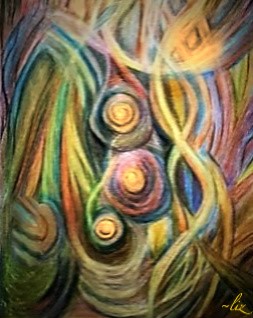
 Note: This reflection is offered by Liz Sorensen Wessel
Metaphors enable us to express divine ineffable truths. The mystery of the Holy Trinity is a Christian understanding of God. One that invites us into a relational experience of love.
Richard Rohr describes God as “a circle dance; a total outpouring and receiving among three intimate partners, who receive their Total Self from another and then hand it on to another, who repeats the self-emptying act of love to a third …”
“All is a constant changing of forms through a nonstop process of loss and renewal, death and resurrection, losing the self and finding a larger self – just as in God and in the teaching of Jesus.” (Rohr)
Theologian and musician, Jeremy S. Begbie explores art as a means of enlivening the gospel beyond the confines of words. He views the integration of art and faith akin to learning a new language; a bridge between our limited perceptions and world view to new understanding and the discernment of meaning in our lives.
The delight of self-expression through art has been universal throughout the ages. This can be seen in ancient cave drawings, the composing of music, of painting beauty in vibrations of colors and prose and in dancing to the movements of life (to name a few).
Begbie suggests that we consider the notes that form the C Major chord as an analogy for the trinity. When the solo note of C is played it fills the entire air with sound. As a second E note is added, the two combined notes fill space so that you can’t tell where one note begins or the other leaves off. As the G note joins in, the complete chord vibrates as one integral sound, yet with distinctive parts.
Berber exclaims, “What could be more apt than to speak of the Trinity as a three-note-resonance of life, mutually indwelling, without mutual exclusion and yet without merger, each occupying the same ‘space,’ yet recognizably and irreducibly distinct, mutually enhancing and establishing each other.”
Rohr shares the revelation of Saint Bonaventure, “For God to be good, God can be one. For God to be loving, God has to be two because love is always a relationship.” But his real breakthrough was saying that “For God to be supreme joy and happiness, God has to be three.”
God is relational, and love is revealed in our relationships, our suffering and in our joy. When we see ourselves as separate from one another, we feel cut off; isolated. Yet, we can gift each other along the way by offering an outstretched hand. We can awaken to the divine truth that we too are a part of this all-inclusive love.
Pencil Drawing on black paper by ~liz


 Journal of Sacred Work
Leave a reply to Maureen McDermott Cancel reply