
 Recently, I was in conversation with a colleague, who is also a dear friend, and we reflected upon the toll the pandemic is having on caregivers and on the people we serve. The most recent surge of the Delta variant has become increasingly difficult to navigate as the stress upon caregivers, healthcare systems, our communities and the world has reached epic proportions.
Also, weighing heavy are on our minds and hearts is the devastation and havoc wreaked by unending environmental disasters and the consequences of poverty, war, amd the tragic plight of refugees attempting to flee to safety, racism and political strife. These global concerns are not occurring in isolation but rather points to the interconnectedness of all of life; what affects one, affects the whole.
Throughout this pandemic millions of people have responded to the call to place the common good of others above their persoanl needs to help prevent the spread of COVID. Yet, these acts of moral fortitude are not without cost. Consider the emotional strain of forgoing celebratory occasions such as weddings, anniversaries, graduations, and births and the accompanying feelings of sadness, grief and loss. Just imagine the distress of not being able to be present at the beside of a loved one who is dying or to attend a funeral to grieve within a community of care and belonging. Our lives have lost a sense of normalcy. The impact of extended months of sheltering in, childcare concerns, home schooling, job losses, loss of life, financial worries and social isolation are significant.
Caregivers who serve on the front lines have sacrificed their own family commitments to care for others. Some living in trailers outside their homes, in basements or garages to protect their families from being exposed to the virus. Oh, how they missed being able to hug their children and loved ones.
Many caregivers are beyond a state of burnout and are experiencing moral distress and injury. According to the American Institute of Stress, “Burnout is a cumulative process marked by emotional exhaustion and withdrawal that is associated with increased workload and institutional stress that is not necessarily trauma related.” Symptoms can include depression, disturbed sleep patterns, irritability, cynicism or leaving their profession.
Expert, Wendy Dean points out that there is a critical difference between burnout and moral injury. Moral injury occurs when caregivers are “repeatedly expected, in the course of providing care, to make choices that transgress their long-standing, deeply held commitment to healing.”
“Moral injury comes from knowing you are making that decision in a situation where it didn’t have to happen. That is deeply traumatic.”
“The constraints and lack of supplies and staff, among other pandemic shortfalls, translate to health care providers not able to meet patients’ needs, and that adversely affects their well-being. The frustration of experiencing the new COVID resurgence especially when in many situations the vaccine could have prevented the illness and loss of life.”
When a doctor has to choose who will receive care in situations where there are more patients than ICU beds ethical dilemmas arise. Overtime situations that conflict with one’s values result in moral injury. A nursing colleague shared this with me, “Each time, I feel a piece of my heart getting torn out of me.”
This leads me to wonder, as we live through this pandemic and its aftermath how can we reframe moral injury to promote healing and recovery? As Erie Chapman so passionately counsels, the number one responsibility of a leader is to care for caregivers who care for people (paraphrased). A first step is to acknowledge this current reality and to listen to what caregivers are telling us about what they need, responding to those needs by providing resources and necessary support as well as addressing systemic issues in healthcare.
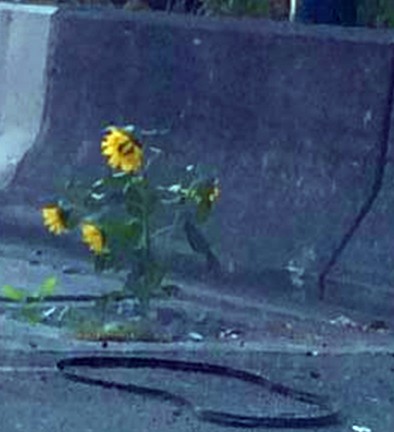
Perhaps we can look to nature to teach us about something about capacity of the human spirit to thrive despite adversity. My friend sent me this photo of a sunflower that is growing through a metal grate of a concrete freeway onramp. Nature offers us profound messages of hope.
I leave you with this beautiful reflection by Mpumelelo Ncwadi from South Africa who highlights the lessons of living with resilience by relying on inner strength held up by the support of community. This is sure to uplift your spirits!
https://www.karmatube.org/videos.php?id=8832
Liz Sorensen Wessel
Note: Wendy Dean, MD, is a psychiatrist and the president and co-founder of Moral Injury of Healthcare, a nonprofit devoted to reframe clinician distress as moral injury.
Photo shared by Melody Fawcett
The essay is based on my reading/learnings from the following sources:
Moral Injury: Pandemic’s Fallout for Health Care Workers (webmd.com)
Moral Injury: The Invisible Epidemic in COVID Health Care Workers (nih.gov)
Reframing Clinician Distress: Moral Injury Not Burnout (nih.gov)
The above sculpture is called Melancolie and it is heartbreakingly beautiful. The artwork created by Albert György (living in Switzerland, but born in Romania) can be found in Geneva in a small park on the promenade (Quai du Mont Blanc) along the shore of Lake Geneva


 Journal of Sacred Work
Leave a reply to Jolyon Cancel reply