

What do the elite veterans of caregiving at hospitals like Riverside Methodist and Nashville’s Baptist (now St. Thomas Midtown) know that new caregivers may not? It is more than what can be discerned from the fragment of papyrus (pictured) that has been preserved like a religious relic because it contains medicine’s most sacred line: “First do no harm.”
Veteran caregivers know that the first word in that Hippocratic Oath is false! Every doctor’s and caregiver’s oath should begin, “First, love your patient.” After that, doing “no harm” will flow naturally because love requires what every patient must have to heal: compassion.
Babies need both food and compassion. The second is too often overlooked. It took the deaths of many babies before medical studies revealed that newborns who were not held lovingly often failed to thrive even when fed.
Why do so many doctors worship science and disdain compassion’s role in healing? Blame the medical schools. Then reform them! As dramatic scientific advances opened new pathways to curing, healing fell by the wayside. The mantra tragically dominating modern medicine remains, “What you can’t measure doesn’t matter.”
In fact, what matters most, love, can never be “measured.”
ATTENTION CAREGIVERS AND LEADERS: Science has discovered measurable evidence of compassion’s value from reliable sources. For example:
- A study cited in Stanford Medicine 25 showed that diabetic patients treated with compassion had an 80% higher likelihood of optimal blood-sugar control, while other research linked it to better overall management of chronic diseases.
- According to the National Institutes of Health, “Compassion helps patients feel safer, leading to more open communication about symptoms, which can lead to better diagnosis and treatment outcomes.”
- Compassionate care reduces unnecessary tests and hospital visits, leading to significantly lower overall healthcare costs, estimated at roughly 50% less in some studies.
- Patients experiencing high levels of compassion from providers often experience reduced pain, lower anxiety, and faster recovery times.
- Research reported in the British Journal of General Practice (April, 2014) indicates that a nurse’s demeanor—specifically their level of empathy, communication style, and ability to build trust—has a direct physiological impact on a patient’s vital signs. The most prominent evidence of this is seen in the “white coat effect,” where the [negative] presence or behavior of a healthcare provider can cause an acute rise in blood pressure and heart rate.
Will things change? An article in Harvard Medical School’s Journal warns that although “it is axiomatic that compassion should be a cornerstone of caring for patients, it is currently debatable if health care provider (HCP) compassion is merely an ‘ought’ … or if HCP compassion itself is an evidence-based intervention with measurable beneficial effects belonging in the science of medicine.”
Now that the evidence is here we must make sure artificial intelligence helps us protect compassion as our most unique blessing. If, instead, Ai steals that, humanity will vanish.
-Erie Chapman, M.T.S., J.D. President Emeritus, Riverside Methodist Hospital, author, Radical Loving Care.
Featured Photo (below) by Tia Ann Chapman for the Hartford Courant
www.eriechapmanfoundation.net : Can Compassion Heal? New Evidence Says Yes.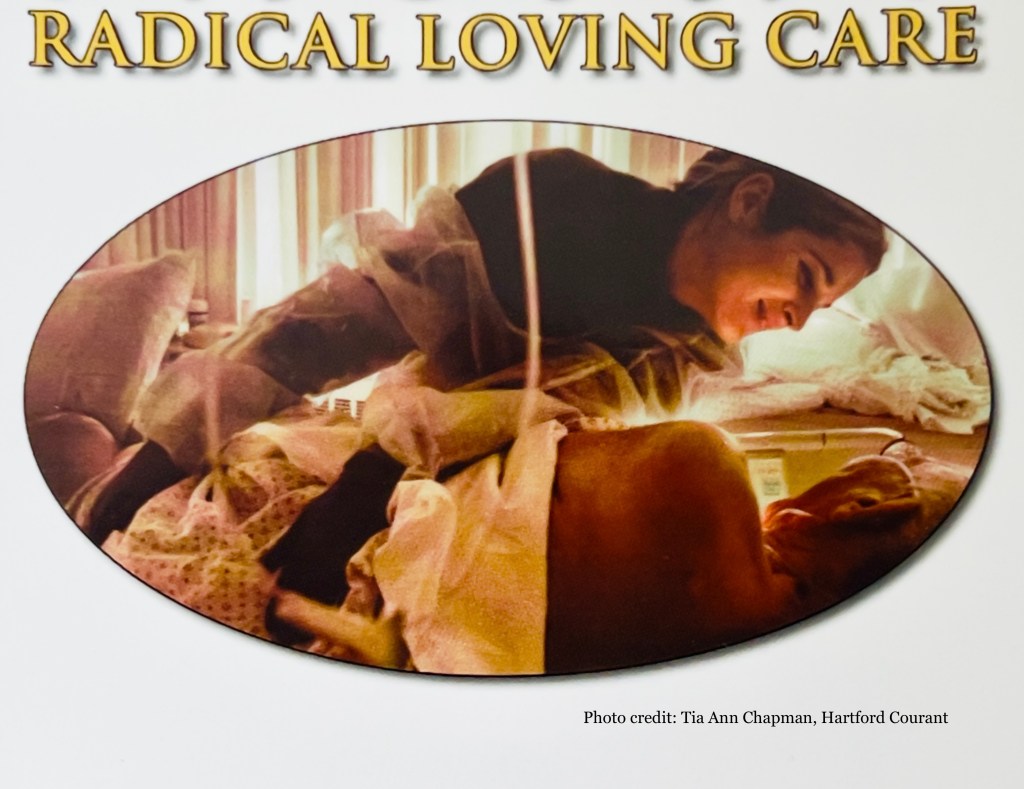

 Journal of Sacred Work
Leave a comment