
 “When we relate to our bodies as having soul, we attend to their beauty, their poetry and their expressiveness. Our very habit of treating the body as a machine, whose muscles are like pulleys and its organs engines, forces its poetry underground, so that we experience the body as an instrument and see its poetics only in illness.”
I did not know then, how my brush with death at such a tender age, would shape the course of my life. Many years passed before I fully understood my mother’s profound influence on me. She stayed by my side in my darkest hour to quell my fears and comfort my soul. I remember her telling me, “I wish I could trade places with you.” My experience of her loving presence in a time of suffering was a cherished gift. Although, I had no words for it, on a deeper level of knowing, I seemed guided to be with people facing a serious illness or at end of life.
Although, as a young nurse I was scared and my first instinct was to turn and run, I realized that this was when people needed someone to be there with them, more than ever.
As caregivers we are invited into people’s lives at very difficult times to bear witness to not only suffering but to tremendous love. People can call upon unfathomable reserves of inner strength, which manifest through the power of Love.
In Erie Chapman’s extraordinary July 31st essay “Days 215-219 – Caring for the Caregiver's Soul,”as well as in his ground breaking book, “Radical Loving Care," he posits the essential need to care for the soul. As I reflect on how to apply this wisdom in my life, the importance of grief work surfaces. I remember the day when the incomprehensible news came. My eldest brother, Phillip as killed in a car accident, the same day as my best friend’s wedding and I was to be her maid of honor. I decided to attend the wedding, which was an extremely strange and surreal experience, as I went through the motions of the day.
In the morning, my brother Johnny and I left New York to join our family in Vermont. Phillip’s funeral was the next day and after the service I took a long plane trip to CA. A kind, older gentleman talked with me the entire trip. I remember we spoke of deeply  meaningful things. (Death has a way of lifting the veil if only for a short time). I am so grateful for the caregiving he provided to me that night.
The following day, I started my very first nursing job on the oncology unit at St Joseph Hospital. I was 22 and no one knew me, my family or what had just occurred. I did not know how to grieve so I just immersed myself in caregiving as I tried to support people who were grappling with life and death situations. Helping them, helped me.
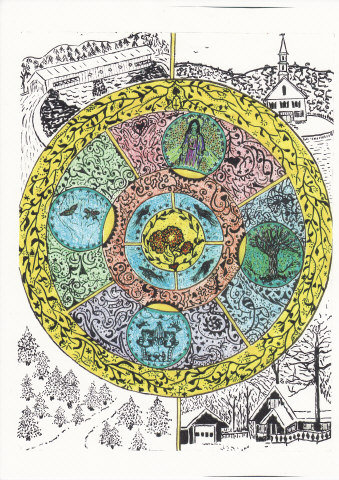
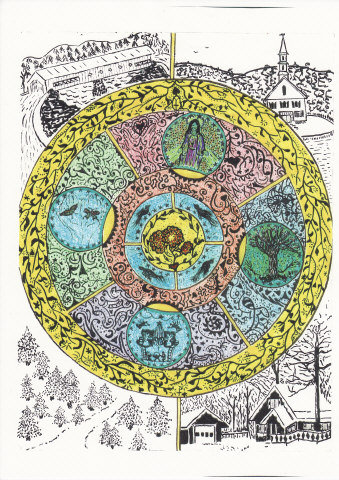
Looking back I wonder how I survived those days. I guess I focused on meeting the needs of others. The patients and families I cared for taught me about the sacredness of living and dying. In 1995, when my dad succumbed to cancer and died, I understood the the necessity of grieving and bleeding off some of the pain of loss by expressing love through journaling and drawing mandalas. These days I also find exercise a great stress reducer and each morning I ground myself with a devotional and/or meditation.
Recently, a colleague at work asked me. "Liz, how are you doing at separating your work life from your home life?" Joyfully, he shared how he has come to completely separate the two. Admittedly, I confessed that I’ve been taking work home at night and on weekends. He said to me, “I wonder what people would think if you brought your laundry to work or perhaps your dirty dishes to wash? “Well”, I said, rather dumbfounded, “I could never even imagine it!” “So, how is that any different from you bringing your work home?” he asked. “Wow, What a powerful analogy”, I said. Those particular images have really stuck with me as I try, or as Erie suggests to find a balance between the “caregiving and caretaking" of one another's souls.
By Liz Sorensen Wessel
Drawings; my parents mandala &Vermont home ~by Liz


 Journal of Sacred Work
Leave a reply to Sherry Cancel reply