
A Celebration of Twenty Years of the Journal of Sacred Work
Erie Chapman has lived a remarkable and multifaceted life. Throughout his career as a trial lawyer, distinguished healthcare leader, and CEO, he has inspired thousands of caregivers across the country to embrace the deeper meaning of compassionate “Radical Loving Care.”
Yet his life reaches far beyond his professional accomplishments. He is a composer, poet, artist, photographer, prolific writer, and filmmaker. He is a Reverend, husband, father, grandfather, author, and dear friend; a seeker of light and a lover of beauty.
At the heart of all these roles is his enduring commitment to awakening the hearts of caregivers. He encourages them to recognize their own courage, persevere through challenges, and offer care that honors the dignity and humanity of every person they serve.
His commitment to social justice has led him to advocate for the most vulnerable among us. He has served people experiencing homelessness, ministered to and accompanied a prisoner on death row, and cared for those he loves. Through these experiences, he has witnessed both the fragility and the extraordinary resilience of the human spirit.
Erie has known ecstasy and deep despair, as well as the profound pain of loss. His has been a life lived with passion, one that has yielded hard-won insights, compassion, and wisdom.
Erie Chapman sees with sacred eyes. He invites us to look beyond the surface of our daily lives and recognize the extraordinary possibilities for love, healing, and connection that exist within the ordinary moments of our human experience.
Celebrating Twenty Years of the Journal of Sacred Work
This year marks the twentieth anniversary of the Journal of Sacred Work (JSW), a remarkable milestone in a journey dedicated to nurturing the spirit of loving care.
At the inception of the Journal, Erie wrote:
“The purpose of this journal is to support the advancement of loving care in America’s hospitals and charities.”
That simple yet profound purpose continues to resonate. The Journal has created a space where caregivers can find encouragement, wisdom, inspiration, and a sense of connection with others who share a commitment to compassionate service.
To fulfill this mission, the Journal has sought to:
- Publish meaningful commentary on the loving care movement and the role of spiritual care.
- Share poetry and meditations that nourish caregivers and support the caregiving journey.
- Recognize organizations and individuals who demonstrate best practices in compassionate care.
- Invite caregivers to share their experiences, insights, and personal reflections through this blog.
In honor of Erie’s dedication to Radical Loving Care, the movement he founded, we celebrate his generosity of spirit and his unwavering belief in the transformative power of love.
The Journal’s extensive archive, spanning two decades, is a treasure trove of reflections, poetry, essays, and artwork. Its pages offer a place to pause, reflect, and reconnect with what matters most. I warmly invite you to explore this collection at your leisure. You may discover, as I have, a passage or poem that speaks directly to your heart at just the moment you need it.
A Life Philosophy Rooted in Love
Among Erie’s many gifts is his willingness to invite us into his own reflections on life, leadership, grief, gratitude, and the spiritual dimensions of caregiving.
In one of his writings, he shared:
“Like lots of people, I’ve relied mostly on the quotes of others to describe my life philosophy. I decided to frame my life philosophy in terms of my own language. I encourage you to do the same as a spiritual exercise.”
He then offered a series of principles that reflect his deeply held convictions. At their center is a belief that love is not simply an emotion, but a way of living and being in the world.
On Love:
“Live love, not fear. Love is everything. If I fill my cup with Love, there is no room for anything else.”
Erie reminds us that Radical Loving Care begins with love and that all his other principles grow from this foundation.
On Leadership:
“The most important job of a healthcare leader is to take care of the people who take care of people. This means living by principles not rules. Principles are for people. Rules are for robots.”
What a powerful reminder that caregivers need to be cared for, too. Leadership grounded in compassion recognizes the humanity of those who serve others.
On Self-Care:
“Take care of yourself so you can take care of others…”
A gentle but essential truth: we must also extend compassion to ourselves if we hope to sustain our compassion for others.
On Gratitude and Forgiveness:
“Gratitude is the mother of joy. Forgiveness is the father of grace.”
On Energy and Joy:
“Where attention goes, energy flows. Change your attention and you change your life. Joy is what matters, not happiness.”
On Compassion:
“Compassion is not a finite liquid to be measured out in cubic centimeters. Compassion is the life blood of Love and the deepest expression of our humanity.”
On Humor:
“Take your work seriously, not yourself. Laughter is essential to joy.”
On Grief:
“Live grief as an essential season in your life.”
On Surrender:
“Surrendering to Love is the most difficult human act, and the most important. It is the only way we can express humility. Prayer aligns us with humility and Love.”
On Art and Music:
“All of great art is an expression of Love. When we engage with art, we have met Love.”
Erie concludes with a principle that brings us back to the heart of his life’s work:
“Every great caregiver lives my first principle: Love, not fear.”
He then leaves us with an invitation to look inward:
“If you were to make up three or five or ten principles of your life, how would you describe them? Which one would be the most important?” —Erie Chapman
What a meaningful spiritual exercise, to consider the principles that guide our lives and ask whether our daily choices reflect what we hold most dear.
Wisdom Gathered Along the Way: Reflections from the Archives
As I revisited some of Erie’s earlier writings, I was reminded of the enduring wisdom woven throughout the Journal. His reflections invite us to slow down, listen more deeply, honor our experiences, and remain open to the sacredness of life.
2008: Remembering the Dreams of Childhood
Erie reflected on his younger self:
“I remember trying to imagine myself at some kind of job (primarily as a cowboy like Hopalong Cassidy) bringing home food, fighting bad guys and building shelter for my imaginary family.”
(Turning 65)
There is something wonderfully human in this glimpse of a young boy imagining the person he might become. Beneath the years of professional achievement and leadership, we can still recognize the child who dreamed, explored, and imagined a life of purpose.
2009: The Sacredness of Silence
Erie shared these words from Ralph Waldo Emerson:
“In silence we must wrap much of our life, because it is too fine for speech.”
He went on to reflect:
“Sacredness is rarely found in velocity. Yet, we chronically find ourselves rushing so we can ‘accomplish more.’ The accomplishments of speed are often among the least important of life’s experiences.”
He then posed two questions that remain especially meaningful for those who care for others:
“How do you experience the rich sanctuary of your own silences? How do you honor the silences of your patients? Do you ever experience a patient’s room as a ‘house of God?’”
These questions invite us to reconsider the place of silence in our lives. In a world that so often rewards speed and productivity, silence can become a sanctuary; a place where we listen without judgment, offer our presence without expectation, and recognize the sacredness of another human being.
Sometimes the most compassionate thing we can offer is not an answer or a solution, but simply the gift of being fully present.
—Erie Chapman
2012: The Gift of Connection
Brené Brown offers this beautiful definition:
“I define connection as the energy that exists between people when they feel seen, heard, and valued; when they can give and receive without judgment; and when they derive sustenance and strength from the relationship.”
These words capture something I have long felt about the Journal of Sacred Work. It is more than a collection of writings. It is a place of connection, a refuge where words can reach across distances and remind us that we are not alone.
In an earlier reflection, I wrote:
“Erie offers a refuge for us in the pages of this Journal. For me, with the ebb and flow of life’s changing landscape and the accompanying need to let go, sometimes my world feels barren and bleak. Yet, each time I come to the Journal I receive a spark of the divine, a lovely flower, a lifeline.”
—Liz Wessel
I continue to treasure these words because they express what this Journal has meant to me personally. Sometimes, amid the uncertainties and losses that accompany life, a few thoughtful words can restore our sense of connection and help us find our way back to hope.
2013: Making Space for the Sacred
Erie shared a thought from Wayne Muller:
“Prayer is like a portable Sabbath, when we close our eyes for just a moment and let the mind rest in the heart.”
Reflecting on his own birthday, Erie observed that the noise surrounding Halloween had sometimes interfered with his ability to celebrate the day as a personal Sabbath. He recognized that something deeply meaningful can become lost amid the distractions and demands of the world.
He invited readers to consider:
“What is most ‘deeply true’ about your life? What do you want to become more true? What would happen if you looked beneath the ‘artificial urgency’ of the world’s demands?”
What a beautiful invitation to pause and reclaim the sacredness of our lives. Perhaps we can begin by creating a little space each day for stillness, prayer, gratitude, or quiet reflection; a moment to listen to the wisdom of our own hearts.
—Erie Chapman
2015: Honoring the History of Love
Erie drew inspiration from the poet W. S. Merwin:
“I tell parts of a story / that once occurred / and I laugh with surprise at what disappeared / though I remember it so well.”
He then offered this poignant reflection:
“When we dishonor a once-meaningful relationship or a lost job we demean ourselves. Because one knife cut us do we have to tarnish every piece of silver in memory’s drawer?”
And then, perhaps most tenderly:
“You were not a fool to love. Why become one by degrading love’s history?”
Erie reminds us that heartbreak need not erase the beauty of what once was. Relationships change, people leave, and circumstances sometimes bring painful endings. Yet the love we experienced remains part of our story.
To heal is not necessarily to forget or to deny our pain. It is to make room for the whole of our experience; the joy as well as the sorrow, and to honor what was meaningful without allowing loss to define everything that follows.
As Erie writes:
“Replacing heart-break with heart-joy requires healing not curing.”
—Erie Chapman
2016: The Good Heart
Erie asked:
“Where is salvation?”
He offered this reflection:
“Having a good heart allows us to love the shadows as well as the sun that creates them. That love can only be found in slow breaths.”
He continued:
“Speed tramples compassion, destroys Radical Loving Care & causes spiritual blindness. Race through your days & you will miss the world’s beauty.”
Erie recalled the Dalai Lama’s belief that the only true religion consists of having a good heart, alongside the words of Jesus: “God is Love.”

Here, once again, we find the heart of Erie’s message. To cultivate a good heart requires that we slow down enough to see, to recognize beauty, acknowledge suffering, and meet others with compassion. It asks us to embrace not only the light in our lives but also the shadows that deepen our understanding of ourselves and one another.
Perhaps the invitation is simply to breathe, to notice, and to love more generously.
—Erie Chapman
A Birthday Blessing for Erie
In honor of your birthday, dear Erie, I offer you this blessing:
Blessed are you
who work with goodness,
who stand for the right,
who live in truth.
For you come to know the Friend
who dwells in the secret room
of your heart.
You are like an acorn planted
in fertile soil
that grows into a mighty oak.
Your work blesses others,
you radiate love;
joy delights your heart.
—From Meditations and Mandalas by Nan C. Merrill
A Closing Reflection
As we celebrate twenty years of the Journal of Sacred Work, we celebrate far more than the passage of time. We celebrate a vision that continues to invite us toward a more compassionate world; one in which caregivers are honored, the vulnerable are seen, and love is recognized as an essential expression of our shared humanity.
Erie’s writings remind us that sacredness is not reserved for extraordinary moments. It can be found in a quiet room, a compassionate gesture, a work of art, a moment of prayer, or the simple act of listening with an open heart.
His legacy lives in the countless individuals who have been touched by his words and inspired by his example. It lives in every caregiver who chooses love over fear, every leader who supports those entrusted with the care of others, and every person who pauses long enough to recognize the sacredness in another.
Erie, thank you for creating this refuge of wisdom, beauty, and connection. Thank you for reminding us that compassion is not a limited resource, that grief can become a doorway to healing, and that joy is nurtured when we turn our attention toward what matters most.
May the Journal of Sacred Work continue to be a beacon of light, offering readers, for years to come, a place to pause, reflect, and rediscover the light within themselves and one another.
And may we all learn, in our own ways, to see with sacred eyes.
Shared by Liz Sorensen Wessel
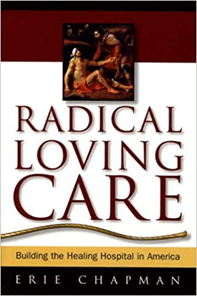
Note: Photos from cover of the book, “Radical Loving Care” by Erie Chapman and photo of caregiver with patient by Tia Chapman


Leave a Reply